

Loading
  • Link to Instagram
How to rabbit
  • Home
  • Getting a Rabbit
    • Before You Get Rabbits
      • Rabbit Care for Beginners
      • Rabbit Care in 15 Minutes
      • How Much Do Rabbits Cost?
      • Lop Rabbits: Health & Welfare Concerns
      • Rabbit Lifespan: How Long Do Rabbits Live?
    • Choosing & Bringing Home Rabbits
      • Bringing a Rabbit Home
      • Sexing Rabbits: Male or Female?
      • Neutering Male Rabbits
      • Rabbits and Other Pets
      • Rabbit Adoption Contract
  • Housing
    • Outdoor Housing
      • Winter Care for Rabbits
      • Keeping Rabbits in the Garden
      • Building an Outdoor Rabbit Enclosure
      • Overwintering Rabbits
      • Outdoor Rabbit Run Ideas
    • Indoor Housing
      • Rabbit Litter Training Guide
      • Setting Up a Rabbit Room
      • Vitamin D for Indoor Rabbits
      • Keeping Rabbits Indoors
      • Indoor Rabbit Housing Ideas
      • Keeping Rabbits Cool in Summer
    • Balcony Housing
      • Keeping Rabbits on a Balcony
      • Rabbit-Friendly Balcony
  • Feeding
    • Foods for Rabbits
      • Grass & Meadow Plants
      • Pellets for Rabbits
      • Vegetables
      • Culinary herbs
      • Fruits for rabbits
      • Water & Drinking
    • Feeding Guidelines
      • Feeding Guidelines
      • Common Feeding Mistakes
      • Rabbit Feeding Myths
      • How to Feed a Baby Rabbit
    • Feeding tips
      • How to Transition a Rabbit to a New Diet Safely
      • Winter Diet for Rabbits
      • Nutrition for Young Rabbits
      • Diet Changes in Young Rabbits
    • Nutrition Basics
      • What can rabbits eat?
      • Types of Rabbit Diets
      • Is Hay the Main Food for Rabbits?
      • Tooth Wear & Dental Health
      • Crude Fiber & Carbohydrates
      • Secondary Plant Compounds
      • Food selection
      • Between Scarcity and Abundance
      • Rabbit Digestion
      • Wild Rabbit Nutrition
    • Foraging & Plant Identification
      • Foraging Meadows for Beginners
      • Identifying Coniferous Trees
      • Highly toxic plants
    • Food & Plant Lists
      • Safe Branches for Rabbits
      • Best Vegetables for Rabbits
      • Wild Grasses for Rabbits
      • Aromatic Herbs for Rabbits
      • Foraging & Plant Identification
      • Garden plant list
      • Fruit list
  • Companionship & Bonding
    • Rabbit Bonding
    • After a Rabbit Dies: Should the Other Rabbit Live Alone?
    • Can Rabbits Live Alone?
    • Choosing the Right Rabbit Companion
    • Rabbit Bonding Methods
    • Common Bonding Mistakes
    • Bonding of Young Rabbits
    • Keeping Rabbits in Large Groups
    • Hierarchy Fights & Bullying
    • Bonding Disabled or Ill Rabbits
    • Rabbit Socialization
  • Behavior
    • Handling Rabbits
    • Common Behaviors & Problems
      • Rabbits that don’t get along
      • Handling traumatized rabbits
      • Nibbling & Chewing
      • Digging
      • Humping
      • Kicking, Scratching & Wriggling
      • Biting & Aggressive Behavior
    • Body Language & Senses
      • Rabbit Senses
  • Health
    • General Health
      • Is My Rabbit Sick?
      • Recognizing Pain in Rabbits
      • Sudden Death in Rabbits: Possible Causes
      • Rabbit Health Myths
    • Digestive Disorders
      • Gastric Dilatation in Rabbits
      • Bloating in Rabbits
      • Hairballs & Constipation
      • Rabbit Diarrhea & Mushy Poop
      • Stomach Overload
      • Coccidia in Rabbits
      • Yeast in Rabbits
      • Worms in Rabbits
      • Underweight & Overweight Rabbits
      • Megacolon Syndrome
      • Bacterial Enteritis
      • Appendicitis in Rabbits
    • Skin, Fur & Parasites
      • Molting
      • Flystrike in Rabbits (Myiasis)
      • Mites, Ticks, Fleas & Other Parasites
      • Ear Mites
      • Skin Fungus
      • Wounds & Bite Wounds
      • Abscesses
      • When Rabbits Lick Themselves Raw
      • Sore Hocks in Rabbits
      • Injection Necrosis
      • Tumors & Cancer in Rabbits
      • Skin Inflammation
    • Infectious Diseases
      • Rabbit Snuffles
      • E. cuniculi in Rabbits
      • Rabbit Hemorrhagic Disease (RHD)
      • Myxomatosis
      • Ear Infection
      • Rabbit Syphilis
      • Tularemia (Rabbit Fever)
      • Tetanus
      • Toxoplasmosis
      • Listeriosis
      • Rodentiosis
      • Herpesviruses in rabbits
    • Internal & Organ Diseases
      • Liver Diseases
        • Liver Lobe Torsion
      • Cystitis
      • Bladder Sludge & Bladder Stones
      • Kidney Failure
      • Sex & Neutering
      • Uterine Diseases
      • Heart Diseases
      • Thyroid Diseases
      • Heatstroke in Rabbits
      • Stroke in rabbits
      • Schock
      • Hormonal Disorders
    • Other Health Conditions
      • Floppy Rabbit Syndrome
      • Dental Diseases
        • Jaw Abscesses
        • Nutrition for Dental Disease
      • Eye Diseases in Rabbits
        • Watery Eyes
      • Joint Diseases
      • Bone Fractures & Accidents
      • Cramps & Seizures
      • TThymoma, Lymphoma & Other Tumors
      • Poisoning in Rabbits
      • Mold & Mycotoxins
  • Care
    • Rabbit Poop & Urine: What It Means
    • Housing for Disabled & Elderly Rabbits
    • Wheelchairs & Mobility Support for Rabbits
    • Rabbit Health Check
    • Dirty Bottom in Rabbits
    • Why Does My Rabbit Pee & Poop Everywhere?
    • Saying Goodbye to a Rabbit
  • Offspring
    • Breeding that causes animal suffering
  • Service
    • News
    • About Us
    • Legal Disclosure
    • Privacy Policy
  • Click to open the search input field Click to open the search input field Search
  • Menu Menu

What Grasses Can Rabbits Eat? Complete Safe Grass Guide for Rabbits

With Ctrl + F you can easily search this list. On smartphones, the search bar sometimes needs to be confirmed with Enter.


Contents

  • How Much Grass Can Rabbits Eat?
  • Are There Poisonous Grasses for Rabbits?
  • Important Safety Warning: Awns Are Dangerous
  • Young Grass or Mature Grass – What Is Better for Rabbits?
  • Young Grass (Spring Grass)
  • Older / Mature Grass
  • Flowering Grass
  • How to Identify Grasses
  • List of Safe Grasses Rabbits Can Eat
  • Black-grass (Alopecurus myosuroides)
  • Foxtail Millet (Setaria)
  • Ryegrass / Perennial Ryegrass / Italian Ryegrass (Lolium perenne, Lolium multiflorum)
  • Tall Oat-Grass (Arrhenatherum elatius)
  • Pendulous Sedge (Carex pendula)
  • Barnyard Grass (Echinochloa crus-galli)
  • Crested Dog’s-Tail (Cynosurus cristatus)
  • Cocksfoot / Orchard Grass (Dactylis glomerata)
  • Tufted Hair-Grass (Deschampsia cespitosa)
  • Rough Meadow-Grass (Poa trivialis)
  • Cattail / Bulrush (Typha latifolia)
  • Kentucky Bluegrass / Meadow Grass (Poa pratensis)
  • Sweet Vernal Grass (Anthoxanthum)
  • Common Reed (Phragmites australis)
  • Tall Fescue / Red Fescue (Festuca arundinacea)
  • Bentgrasses (Agrostis species)
  • Bromes (Bromus sterilis, Bromus hordeaceus)
  • Reed Grass (Calamagrostis arundinacea)
  • Meadow Foxtail (Alopecurus pratensis)
  • Golden Oat-Grass (Trisetum flavescens)
  • Timothy Grass (Phleum pratense)
  • Yorkshire Fog (Holcus lanatus)
  • Quaking Grass (Briza media)
  • Couch Grass (Elymus)
  • Final Summary

How Much Grass Can Rabbits Eat?

Grasses play a major role in a rabbit’s natural diet. When feeding meadow forage, grass should make up around 20–90% of the portion.


Are There Poisonous Grasses for Rabbits?

Most true grasses (Poaceae) are safe for rabbits.

However:

  • Golden oat-grass can cause dangerously high vitamin D intake and may become toxic depending on the amount.
  • Fungal toxins (endophytes) can occur on grasses, but in normal quantities they usually do not pose a problem for rabbits.

Important Safety Warning: Awns Are Dangerous

Awns (the sharp barbed bristles on cereal heads and flowering grasses) may look harmless, but they are extremely dangerous.
They can penetrate the rabbit’s skin and migrate inside the body like arrow tips. Avoid them completely.
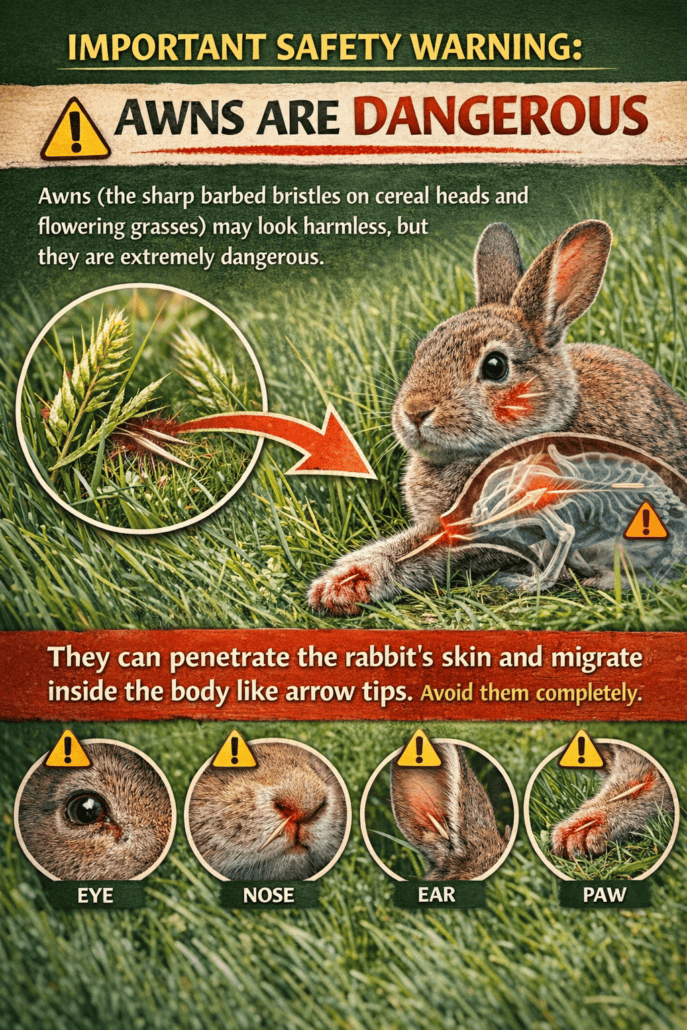
Sharp rabbit bristles and internal anatomy warning for rabbit safety and handling.

Young Grass or Mature Grass – What Is Better for Rabbits?

Young Grass (Spring Grass)

  • High in energy
  • High in protein
  • Low in fiber
    ➡ Rabbits must be slowly accustomed over about 10 days, especially the first two days, to avoid digestive issues.
    Great for underweight rabbits.

Older / Mature Grass

  • High in structural fiber (supports digestion)
  • Low in energy
    ➡ Perfect for overweight rabbits and general digestive stability. Most pet rabbits are fed too much energy, so older grasses are ideal.

Flowering Grass

Often has little nutritional value and is extremely low in energy.
But be careful: the flower heads themselves are energy-rich and not suitable for overweight rabbits.


How to Identify Grasses

Grasses are easiest to identify when they are in bloom.
The Flora Incognita app works very reliably for identification.
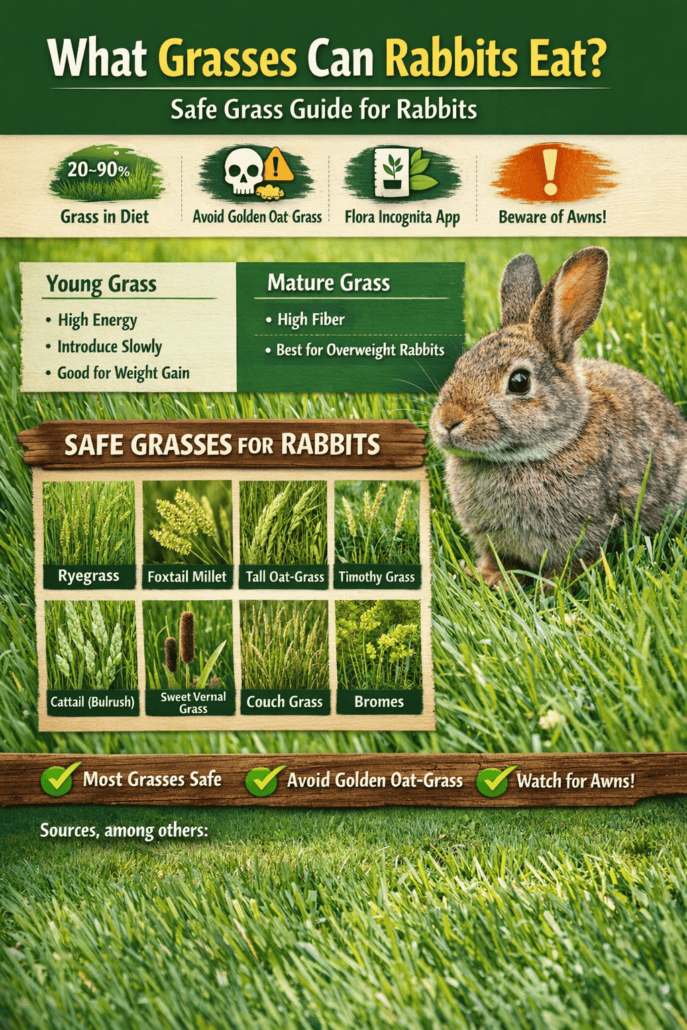
Lush grass and safe plants for rabbits, including ryegrass, Timothy grass, and couch grass.
A rabbit sitting in a grassy field, highlighting safe grass options for rabbits’ diet.

List of Safe Grasses Rabbits Can Eat

Below is a comprehensive list of safe rabbit grasses, including nutritional notes and suitability.


Black-grass (Alopecurus myosuroides)

Low-energy, ideal for rabbits.

Foxtail Millet (Setaria)

Safe and suitable, rather sparse but good forage.

Ryegrass / Perennial Ryegrass / Italian Ryegrass (Lolium perenne, Lolium multiflorum)

Energy-rich but feedable. Lower-energy grasses are preferable.

Tall Oat-Grass (Arrhenatherum elatius)

Safe to feed.

Pendulous Sedge (Carex pendula)

Edible, usually eaten reluctantly. Belongs to sedges.

Barnyard Grass (Echinochloa crus-galli)

Safe for rabbits. Indicator of nitrogen-rich soils.

Crested Dog’s-Tail (Cynosurus cristatus)

Edible.

Cocksfoot / Orchard Grass (Dactylis glomerata)

Very suitable rabbit forage. Flowers May–June.

Tufted Hair-Grass (Deschampsia cespitosa)

Safe to feed.

Rough Meadow-Grass (Poa trivialis)

Common, edible, slightly energy-rich. Prefers moist and shady areas.

Cattail / Bulrush (Typha latifolia)

Edible. Grows in wetlands and near water.

Kentucky Bluegrass / Meadow Grass (Poa pratensis)

Very widespread, slightly energy-rich, safe to feed.

Sweet Vernal Grass (Anthoxanthum)

Energy-poor, safe to feed, sometimes smells like woodruff.

Common Reed (Phragmites australis)

Low energy, safe for rabbits. Grows near water, flowers July–September.

Tall Fescue / Red Fescue (Festuca arundinacea)

Safe.

Bentgrasses (Agrostis species)

Safe.

Bromes (Bromus sterilis, Bromus hordeaceus)

Low in energy, suitable rabbit forage.

Reed Grass (Calamagrostis arundinacea)

Safe.

Meadow Foxtail (Alopecurus pratensis)

Nutrient-rich, edible for rabbits. Flowers April–July.

Golden Oat-Grass (Trisetum flavescens)

⚠ Dangerous in excess due to vitamin D overdose risk. Can act toxic depending on intake.

Timothy Grass (Phleum pratense)

Very common rabbit grass. Completely safe.

Yorkshire Fog (Holcus lanatus)

Safe. Flowers May–August.

Quaking Grass (Briza media)

Safe to feed.

Couch Grass (Elymus)

Completely safe.


Final Summary

  • Most grasses are safe for rabbits.
  • Golden oat-grass is the main concern due to vitamin D toxicity risk.
  • Young grass = higher energy → introduce slowly.
  • Older grass = fiber-rich → better for digestion and overweight rabbits.
  • Avoid awns completely due to injury risk.

Sources including

Infection Rates and Alkaloid Patterns of Different Grass Species with Systemic Epichloë Endophytes. Veronika Vikuk, Carolyn A. Young, Stephen T. Lee, Padmaja Nagabhyru, Markus Krischke, Martin J. Mueller, Jochen Krauss. Applied and Environmental Microbiology, DOI: 10.1128/AEM.00465-19


Who Is Behind How to rabbit?

Veterinarian Viola Schillinger
Who Is Behind How to Rabbit? Viola Schillinger is a veterinarian who has kept rabbits since childhood and has dedicated much of her professional life to improving their health, welfare, and living conditions. Decades of rabbit keeping, intensive observation, and professional study have given her extensive experience in rabbit health, nutrition, behavior, and species-appropriate husbandry. She shares her knowledge through television appearances, webinars, podcasts, radio programs, articles, and books. In 2008, Viola founded Kaninchenwiese.de, which has grown into a leading German-language resource for rabbit care and health, reaching around 500,000 visitors per month. How to Rabbit brings this knowledge to an international English-speaking audience. The English content is translated and adapted by Erika Kühne Escobar and medically reviewed by Viola Schillinger.

Rabbits need space…


How to rabbit…

…is a guide for the appropriate keeping, nutrition and care of rabbits.

Search

Search Search

Never alone


Last Changes

  • Neutering Male Rabbits 2. October 2026
  • Cookie Policy (EU) 7. September 2026
  • Care 26. August 2026
  • Fruit list 27. September 2026
  • Highly toxic plants 30. July 2026
© Copyright - How to rabbit 2024 - Enfold Theme by Kriesi
  • Link to Instagram
Scroll to top Scroll to top Scroll to top