
Loading
  • Link to Instagram
How to rabbit
  • Home
  • News
  • Getting a Rabbit
    • Before You Get Rabbits
      • Rabbit Care for Beginners
      • Rabbit Care in 15 Minutes
      • How Much Do Rabbits Cost?
      • Lop Rabbits: Health & Welfare Concerns
      • Rabbit Lifespan: How Long Do Rabbits Live?
    • Choosing & Bringing Home Rabbits
      • Bringing a Rabbit Home
      • Sexing Rabbits: Male or Female?
      • Rabbits and Other Pets
      • Rabbit Adoption Contract
  • Housing
    • Outdoor Housing
      • Winter Care for Rabbits
      • Keeping Rabbits in the Garden
      • Building an Outdoor Rabbit Enclosure
      • Overwintering Rabbits
      • Outdoor Rabbit Run Ideas
    • Indoor Housing
      • Rabbit Litter Training Guide
      • Setting Up a Rabbit Room
      • Vitamin D for Indoor Rabbits
      • Keeping Rabbits Indoors
      • Indoor Rabbit Housing Ideas
      • Keeping Rabbits Cool in Summer
    • Balcony Housing
      • Keeping Rabbits on a Balcony
      • Rabbit-Friendly Balcony
  • Feeding
    • Foods for Rabbits
      • Grass & Meadow Plants
      • Pellets for Rabbits
      • Vegetables
      • Culinary herbs
      • Fruits for rabbits
      • Water & Drinking
    • Feeding Guidelines
      • Feeding Guidelines
      • Common Feeding Mistakes
      • Rabbit Feeding Myths
      • How to Feed a Baby Rabbit
    • Feeding tips
      • How to Transition a Rabbit to a New Diet Safely
      • Winter Diet for Rabbits
      • Nutrition for Young Rabbits
      • Diet Changes in Young Rabbits
    • Nutrition Basics
      • What can rabbits eat?
      • Types of Rabbit Diets
      • Is Hay the Main Food for Rabbits?
      • Tooth Wear & Dental Health
      • Crude Fiber & Carbohydrates
      • Secondary Plant Compounds
      • Food selection
      • Between Scarcity and Abundance
      • Rabbit Digestion
      • Wild Rabbit Nutrition
    • Foraging & Plant Identification
      • Foraging Meadows for Beginners
      • Identifying Coniferous Trees
      • Highly toxic plants
    • Food & Plant Lists
      • Safe Branches for Rabbits
      • Best Vegetables for Rabbits
      • Wild Grasses for Rabbits
      • Aromatic Herbs for Rabbits
      • Foraging & Plant Identification
      • Garden plant list
      • Fruit list
  • Companionship & Bonding
    • Rabbit Bonding
    • After a Rabbit Dies: Should the Other Rabbit Live Alone?
    • Can Rabbits Live Alone?
    • Choosing the Right Rabbit Companion
    • Rabbit Bonding Methods
    • Common Bonding Mistakes
    • Bonding of Young Rabbits
    • Keeping Rabbits in Large Groups
    • Hierarchy Fights & Bullying
    • Bonding Disabled or Ill Rabbits
    • Rabbit Socialization
  • Behavior
    • Handling Rabbits
    • Common Behaviors & Problems
      • Rabbits that don’t get along
      • Handling traumatized rabbits
      • Nibbling & Chewing
      • Digging
      • Humping
      • Kicking, Scratching & Wriggling
      • Biting & Aggressive Behavior
    • Body Language & Senses
      • Rabbit Senses
  • Health
    • General Health
      • Is My Rabbit Sick?
      • Recognizing Pain in Rabbits
      • Sudden Death in Rabbits: Possible Causes
      • Rabbit Health Myths
    • Digestive Disorders
      • Gastric Dilatation in Rabbits
      • Bloating in Rabbits
      • Hairballs & Constipation
      • Rabbit Diarrhea & Mushy Poop
      • Stomach Overload
      • Coccidia in Rabbits
      • Yeast in Rabbits
      • Worms in Rabbits
      • Underweight & Overweight Rabbits
      • Megacolon Syndrome
      • Bacterial Enteritis
      • Appendicitis in Rabbits
    • Skin, Fur & Parasites
      • Molting
      • Flystrike in Rabbits (Myiasis)
      • Mites, Ticks, Fleas & Other Parasites
      • Ear Mites
      • Skin Fungus
      • Wounds & Bite Wounds
      • Abscesses
      • When Rabbits Lick Themselves Raw
      • Sore Hocks in Rabbits
      • Injection Necrosis
      • Tumors & Cancer in Rabbits
      • Skin Inflammation
    • Infectious Diseases
      • Rabbit Snuffles
      • E. cuniculi in Rabbits
      • Rabbit Hemorrhagic Disease (RHD)
      • Myxomatosis
      • Ear Infection
      • Rabbit Syphilis
      • Tularemia (Rabbit Fever)
      • Tetanus
      • Toxoplasmosis
      • Listeriosis
      • Rodentiosis
      • Herpesviruses in rabbits
    • Internal & Organ Diseases
      • Liver Diseases
        • Liver Lobe Torsion
      • Cystitis
      • Bladder Sludge & Bladder Stones
      • Kidney Failure
      • Sex & Neutering
      • Uterine Diseases
      • Heart Diseases
      • Thyroid Diseases
      • Heatstroke in Rabbits
      • Stroke in rabbits
      • Schock
      • Hormonal Disorders
    • Other Health Conditions
      • Floppy Rabbit Syndrome
      • Dental Diseases
        • Jaw Abscesses
        • Nutrition for Dental Disease
      • Eye Diseases in Rabbits
        • Watery Eyes
      • Joint Diseases
      • Bone Fractures & Accidents
      • Cramps & Seizures
      • TThymoma, Lymphoma & Other Tumors
      • Poisoning in Rabbits
      • Mold & Mycotoxins
  • Care
    • Rabbit Poop & Urine: What It Means
    • Housing for Disabled & Elderly Rabbits
    • Wheelchairs & Mobility Support for Rabbits
    • Rabbit Health Check
    • Dirty Bottom in Rabbits
    • Why Does My Rabbit Pee & Poop Everywhere?
    • Saying Goodbye to a Rabbit
  • Offspring
    • Breeding that causes animal suffering
  • Service
    • About Us
    • Legal Disclosure
    • Privacy Policy
  • Click to open the search input field Click to open the search input field Search
  • Menu Menu

Crude fiber & carbohydrates

Contents

  • Crude fiber plays a major role in rabbit nutrition. But why is that?
  • How does the cecum work?
  • Analytical methods
  • What’s behind the different fiber types?
  • Digestibility
  • “Cecal Bacterial Food
  • Comparison between natural feeding (wild plants and fresh grass) and winter feeding or when collection from nature is not possible (hay, leafy vegetables…)

Crude fiber plays a major role in rabbit nutrition. But why is that?

Rabbits have a highly specialized digestive system that not only breaks down food with enzymes, as in dogs and cats, but also digests parts that are indigestible for humans through a unique process in the cecum. This bacterial fermentation in the cecum requires a high ‘crude fiber content.’ However, not all types of crude fiber are the same.
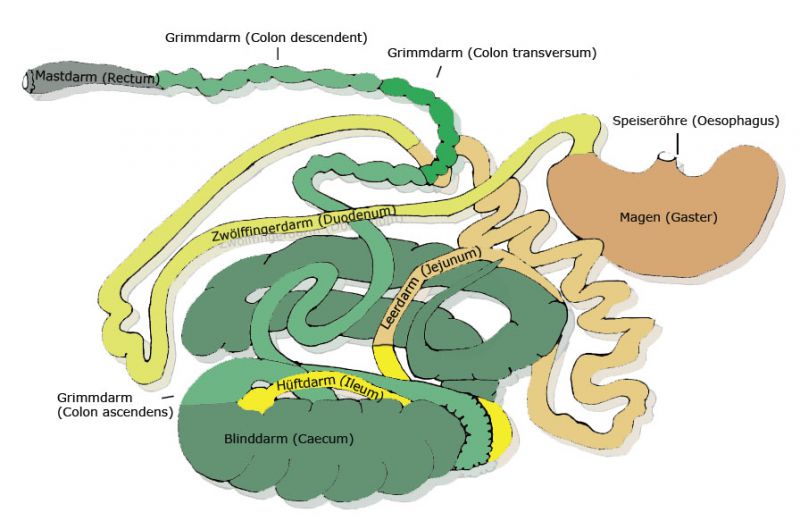
More than half of the digestive tract consists of the cecum. It can be thought of as a large fermentation chamber, where bacteria digest the fibers.

How does the cecum work?

The cecum is home to numerous bacteria that break down fibers indigestible to humans through bacterial fermentation. This process synthesizes fatty acids as well as B and K vitamins. This mechanism is remarkable, as it enables rabbits to digest plants that would not serve as a food source for animals without bacterial fermentation. The cecum provides rabbits with 10-12% of their energy needs in the form of volatile fatty acids. After producing soft feces during the cecal phase, the rabbit excretes this material, re-ingests it, and can then absorb the nutrients through the small intestine.

Analytical methods

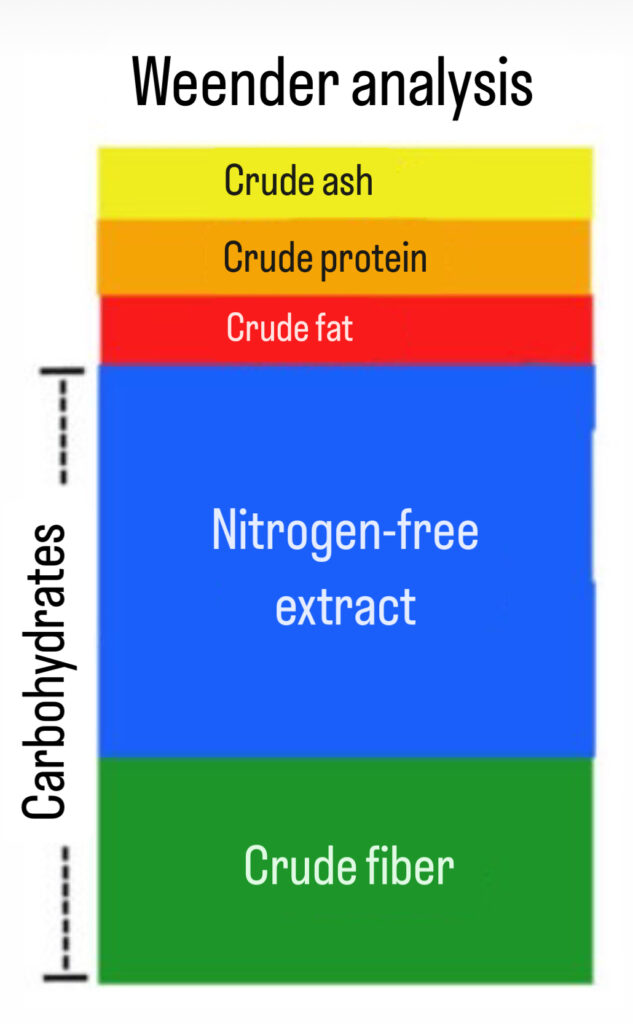
Crude fiber refers to the portion of feed that is insoluble in sulfuric acid and potassium hydroxide, including cellulose, hemicellulose, and lignin. For rabbits, the crude fiber content is not very informative, as it includes both digestible components and indigestible fibers (which are important for gut health).

There are different methods for feed analysis. The ‘crude fiber content’ is determined through the Weende analysis. However, for fiber analysis in rabbit nutrition, the Van Soest analysis is key:
NON-FIBER CARBOHYDRATES (NFC): Non-fiber carbohydrates (NFC) represent the soluble carbohydrates, such as starch, sugars, and pectins, found in feed. These are digested by enzymes outside the cecum. A high NFC content can result in undigested NFCs that disrupt the specialized bacterial flora in the cecum.

NEUTRAL DETERGENT FIBER (NDF): Neutral detergent fiber (NDF) includes hemicellulose, cellulose, and lignin, primarily representing plant cell walls. Typical NDF analysis also captures silica and silicates. NDF essentially consists of fibers that feed cecal bacteria and help maintain digestive stability in rabbits.
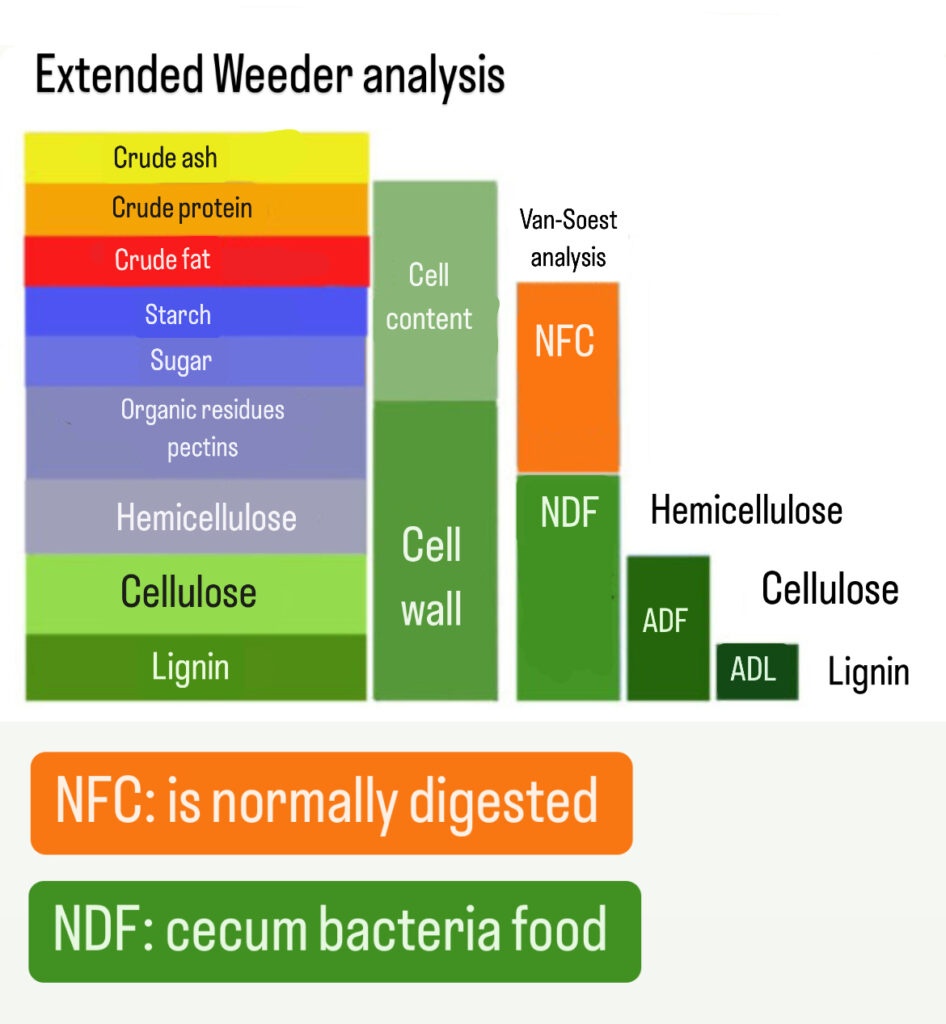
NFC = Non-fibrous carbohydrates (composed of starch, sugar, and pectins)

NDF = Neutral detergent fiber (composed of hemicellulose, cellulose, and lignin)

ADF = Acid detergent fiber (composed of cellulose and lignin)

ADL = Lignin

Hemicellulose = NDF – ADF

Cellulose = ADF – ADL

Lignin = ADL

What’s behind the different fiber types?
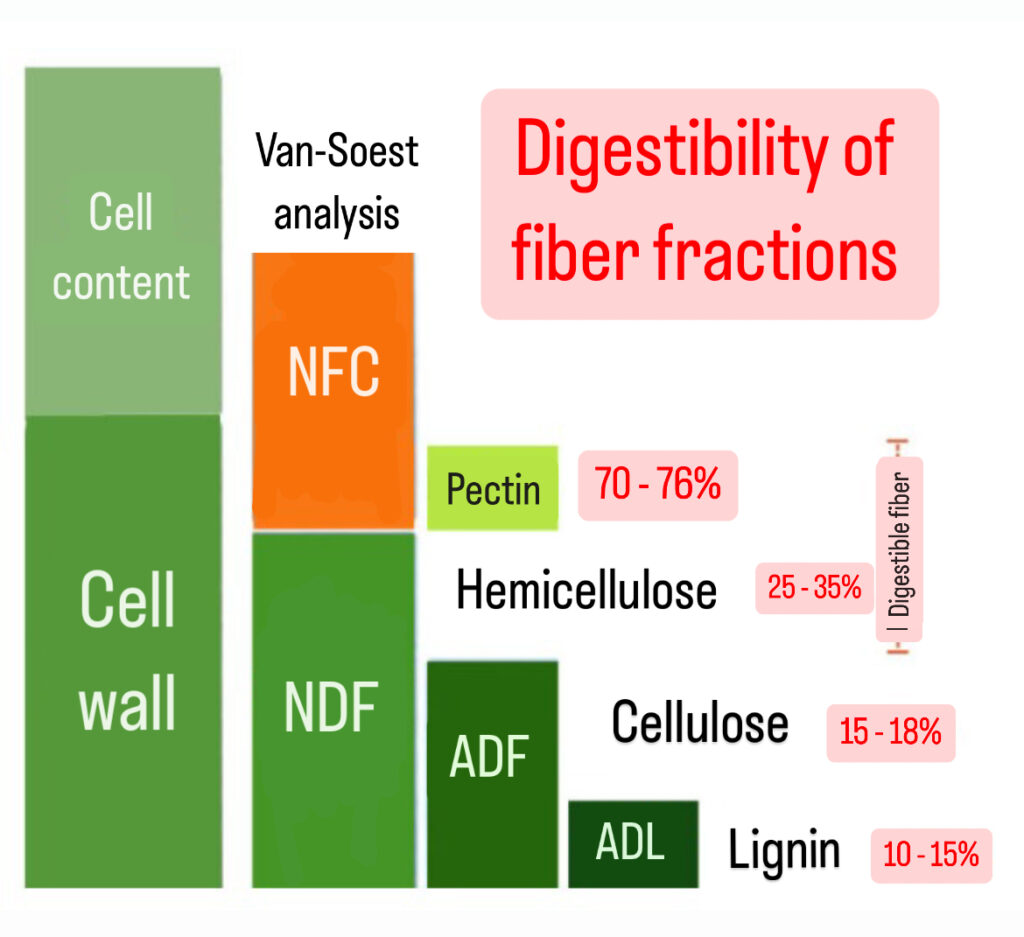
NFC: Primarily digested by enzymes in the small intestine; too much can reach the cecum and cause digestive issues.

  • Sugar (Glucose): High in fruits and also found in sweet-tasting vegetables.
  • Starch: High levels in grains, pea flakes, and also present in fruits and vegetables.
  • Pectins: Found in fruits and vegetables, such as apples and carrots.

NDF: ‘Structural fiber,’ mainly digested in the cecum and colon; serves as ‘bacterial food.’

  • Hemicellulose: High levels in woody plant parts (e.g., grasses, herbs, bark) and present in smaller amounts in fruits and vegetables.

ADF: A high proportion is ideal for digestive health.

  • Cellulose: The main component of plant cell walls.
  • ADL: Lignin.
    • Lignin: Found in highly lignified plants, such as bark, and in smaller amounts in all plants, including vegetables and fruits.

Digestibility

Pectins have a very high digestibility in rabbits, ranging from 70 to 76%, but they also serve as good bacterial food in the cecum.
Hemicelluloses are on average 25 to 35% digestible in rabbits,
Cellulose is between 15 and 18%,
Lignin is on average 10 to 15% digestible.

“Cecal Bacterial Food

According to Gidenne and Lebas (2002), to prevent digestive diseases, the diet should contain more than 15% ADF (cellulose and lignin) and maintain a ratio of ‘digestible fiber’ (hemicellulose and pectins) to ADF of less than 1.3. This means that a higher content of ADF (cellulose and lignin) is beneficial for gut health.

However, the ratio of NDF (starch and sugar) to NFC (hemicellulose, cellulose, lignin) also plays a significant role. An excess of starch and sugar can result in incomplete enzymatic digestion in the digestive tract, leading to these substances reaching the cecum and disrupting the bacterial flora. The result is the excretion of undigested cecal feces due to a bacterial imbalance in the cecum.

The lignin content in the feed should be around 5%, according to studies, to reduce digestive disorders (too little lignin) or prevent restricting feed utilization too much (too much lignin).

Comparison between natural feeding (wild plants and fresh grass) and winter feeding or when collection from nature is not possible (hay, leafy vegetables…)

Two foods may have the same crude fiber content, but be digestible in different proportions, which can either support a healthy digestion or, conversely, overload it. What really matters is the lignin and cellulose content, not the total crude fiber content, as these fractions are ‘cecal food.’

When wild plants and fresh grass are not available, hay is irreplaceable, as leafy vegetables do not contain enough indigestible fibers.

Sources include:

Gidenne, T., Jehl, N., Segura, M., & Michalet-Doreau, B. (2002): Microbial activity in the caecum of the rabbit around weaning: impact of a dietary fibre deficiency and of intake level. Animal Feed Science and Technology, 99(1-4), 107-118.

Gidenne, T. (2000): Recent advances in rabbit nutrition: Emphasis on fibre requirements. A review.
World Rabbit Science 8 (1), 23-32

Gidenne, T. (2015): Dietary fibres in the nutrition of the growing rabbit and recommendations to preserve digestive health: a review. Animal, :(2), 227-242.

Gidenne, T. (2003): Fibres in rabbit feeding for digestive troubles prevention: respective role of low-digested and digestible fibre
Livestock Production Science 81, 105-117

Who Is Behind How to rabbit?

Veterinarian Viola Schillinger
Who Is Behind How to Rabbit? Viola Schillinger is a veterinarian who has kept rabbits since childhood and has dedicated much of her professional life to improving their health, welfare, and living conditions. Decades of rabbit keeping, intensive observation, and professional study have given her extensive experience in rabbit health, nutrition, behavior, and species-appropriate husbandry. She shares her knowledge through television appearances, webinars, podcasts, radio programs, articles, and books. In 2008, Viola founded Kaninchenwiese.de, which has grown into a leading German-language resource for rabbit care and health, reaching around 500,000 visitors per month. How to Rabbit brings this knowledge to an international English-speaking audience. The English content is translated and adapted by Erika Kühne Escobar and medically reviewed by Viola Schillinger.

Rabbits need space…


How to rabbit…

…is a guide for the appropriate keeping, nutrition and care of rabbits.

Search

Search Search

Never alone


Last Changes

  • Cookie Policy (EU) 7. September 2026
  • Care 26. August 2026
  • Fruit list 5. August 2026
  • Highly toxic plants 30. July 2026
  • Appendicitis 21. July 2026
© Copyright - How to rabbit 2024 - Enfold Theme by Kriesi
  • Link to Instagram
Scroll to top Scroll to top Scroll to top