
Appendicitis Is Particularly Common in Summer and Autumn
Appendicitis, an inflammation of the vermiform appendix attached to the cecum, was rarely described in pet rabbits for many years. In recent years, however, it has become apparent that this condition occurs more frequently than previously assumed. An increased number of cases appears to occur particularly during the summer and autumn months.
Because the symptoms are nonspecific and can easily be confused with other gastrointestinal disorders, early recognition is important. With the appropriate treatment, the prognosis is often good.

What Is the Appendix in Rabbits?
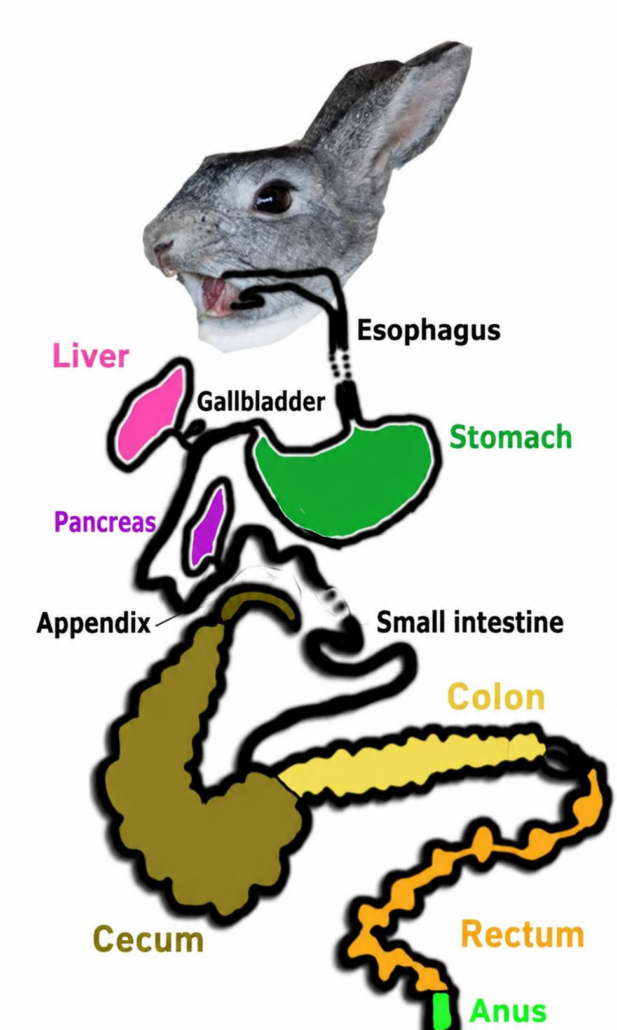
The rabbit’s cecum is extremely large, accounting for approximately 60% of the entire digestive tract. At the end of the cecum is a thin-walled, pouch-like structure measuring approximately 7–12 cm in length: the appendix.
It contains an exceptionally large amount of lymphatic tissue and therefore many immune cells. As a result, it reacts sensitively to inflammation, similarly to the human vermiform appendix. Inflammation of the appendix is known as appendicitis.
Causes: Why Does Appendicitis Occur?
The exact cause has not yet been conclusively established.
What is currently known:
- Most affected rabbits are young animals under three years of age.
- No particular breed or sex appears to be affected more frequently.
- Cases occur more commonly in summer and autumn.
- Bacteria that may be involved include:
- E. coli
- Yersinia pseudotuberculosis
- Klebsiella variicola
- Pseudomonas aeruginosa
Because the appendix acts as a type of immune centre within the intestine, these structures may be particularly sensitive to disruptions of the intestinal microbiome, infections or inflammatory stimuli.
Symptoms: When Should Appendicitis Be Suspected?
Because the condition is uncommon in dogs and cats and its symptoms are relatively nonspecific, it was probably overlooked in rabbits for many years. It has only been diagnosed more frequently in recent years.
The symptoms are nonspecific and resemble those of many other digestive disorders:
- Reduced or complete loss of appetite
- Lethargy, withdrawal and lack of responsiveness
- Abdominal pain, including a hunched or protective posture
- Teeth grinding
- Passing fewer or no droppings
- Fever in approximately half of all cases
- In rabbits, a temperature above 39.5°C is considered a fever.
Fever is unusual in rabbits with digestive disorders and is therefore an important diagnostic clue.
In some cases, the veterinarian may be able to feel a firm, tube-like structure in the middle of the abdomen.
Important: Appendicitis is one of the few gastrointestinal diseases in rabbits in which fever occurs frequently.
Differential Diagnoses
Because the symptoms are so similar to those of other conditions, the following diseases are often suspected first.
Possible causes of fever include:
- RHDV2
- Heatstroke
- Liver lobe torsion
- Peritonitis
- Pain or severe stress
Possible causes of a palpable mass or enlargement in the middle of the abdomen include:
- Constipation or obstruction in the cecum or colon
- An intestinal foreign body
- Changes affecting the uterus
- Abscesses
- Kidney or ureteral disorders
Diagnostic imaging is required to determine reliably whether the appendix is involved.
Diagnosis: How Does a Veterinarian Identify Appendicitis?
Appendicitis is extremely difficult to diagnose without an ultrasound examination.
Palpation
In approximately half of affected rabbits, the appendix can be felt as a tube-like thickening in the middle of the abdomen.
Ultrasound — the Most Important Examination
On ultrasound, the appendix appears as an enlarged, thickened, tube-like structure. It may be:
- Severely thickened and enlarged
- Filled with fluid
- Hypoechoic, meaning that its wall appears dark on ultrasound
- Surrounded by inflamed fatty tissue
- Associated with free fluid in the abdominal cavity, known as ascites
In healthy rabbits, the appendix wall is approximately 0.11–0.21 cm thick, with an overall diameter of approximately 0.39–0.88 cm.
The sacculus rotundus, a structure located between the ileum and the cecum, may also be inflamed.
X-Ray
X-rays can be helpful but are not conclusive. They are particularly useful for ruling out other digestive disorders.
Possible findings include:
- Mildly gas-filled sections of the intestine
- Occasionally, changes affecting the urinary bladder
Blood Tests
Typical findings may include:
- Anemia
- Low blood glucose
- Azotemia
- Hyperphosphatemia
- Leukopenia rather than leukocytosis
- Hyperproteinemia
- Hypoalbuminemia
- A total protein-to-albumin ratio of approximately 1:1
- Occasionally elevated urea levels due to dehydration
Elevated blood glucose may also occur, but this is less common.
CT Scan
Computed tomography is highly informative but is only rarely available. It can clearly show changes in the appendix and often reveals free fluid within the abdominal cavity.
Treatment: Conservative Management or Surgery?
Treatment depends on the severity of the condition.
Conservative Treatment — Successful in Most Cases
Conservative treatment may include:
- Intensive fluid therapy using intravenous infusions
- A shock fluid bolus when necessary
- Pain medication
- Antibiotics, such as enrofloxacin, marbofloxacin or metronidazole
- Medication to support the stomach and intestines
- Assisted feeding when necessary
Many rabbits show a noticeable improvement within 24–48 hours.
Studies report varying success rates, but the prognosis with conservative treatment can be very good when rabbits receive appropriate and intensive care.
When Is Surgery Necessary?
Surgery may be appropriate when:
- The rabbit does not improve after 24–48 hours of intensive treatment
- Ultrasound or CT imaging reveals severe changes
- Complications occur
The surgical procedure is an appendectomy, meaning removal of the appendix. The abdomen is opened, and the appendix is carefully exposed and removed.
Important: The rabbit’s intestinal walls are extremely thin, so this operation requires considerable surgical experience. Rabbits that are already weak also face an increased anesthetic risk. Their sensitive gastrointestinal system creates an additional challenge. According to the published literature, the survival rate following surgery is approximately 63%.
In rabbits, the appendix is a central lymphatic organ. It is involved in B-cell development and T-cell maturation from an early age and remains an important part of the gut-associated immune system in adult animals. Its removal could therefore potentially have long-term effects on immune function.
Acting quickly when a rabbit stops eating can save its life, as many illnesses in rabbits develop rapidly and can become life-threatening.
Sources include:
Böttcher, A. (2024). Appendizitis beim Kaninchen–eine Erkrankung auf dem Vormarsch?. kleintier konkret, 27(S 02), 4-13.
Dierig, J. A., Willems, A., Krull, M., Gerhauser, I., Pees, M., & Reuschel, M. (2024): Nachweis von Klebsiella variicola bei Hauskaninchen mit eitriger Appendizitis. Kleintierpraxis, 69(8), 418-428.
Di Girolamo N, Petrini D, Szabo Z. et al. (2001): Clinical, surgical, and pathological findings in client-owned rabbits with histologically confirmed appendicites: 19 cases (2015–2019). J Am Vet Med Assoc 2021; 260: 82-93
Harder, K., & Thöle, M. (2025). Das inappetente Kaninchen–ein Notfallpatient. kleintier konkret, 28(S 01), 2-9.
Jekl V, Piskovska A, Drnkova I. et al (2001): Case report: spontaneous appendicitis with suspected involvement of Klebsiella variicola in two pet rabbits. Front Vet Sci 2021; 8: 779517
Longo M, Thierry F, Eatwell K. et al. (2018): Ultrasound and computed tomography of sacculitis and appendicitis in a rabbit. Vet Radiol Ultrasound 2018; 59: E56-E60
Thöle M. (2022): Appendizitis beim Kaninchen – Symptome, weiterführende Diagnostik und konservativer Therapieansatz anhand von 5 Fallbeispielen. 4. Augsburger Thementage