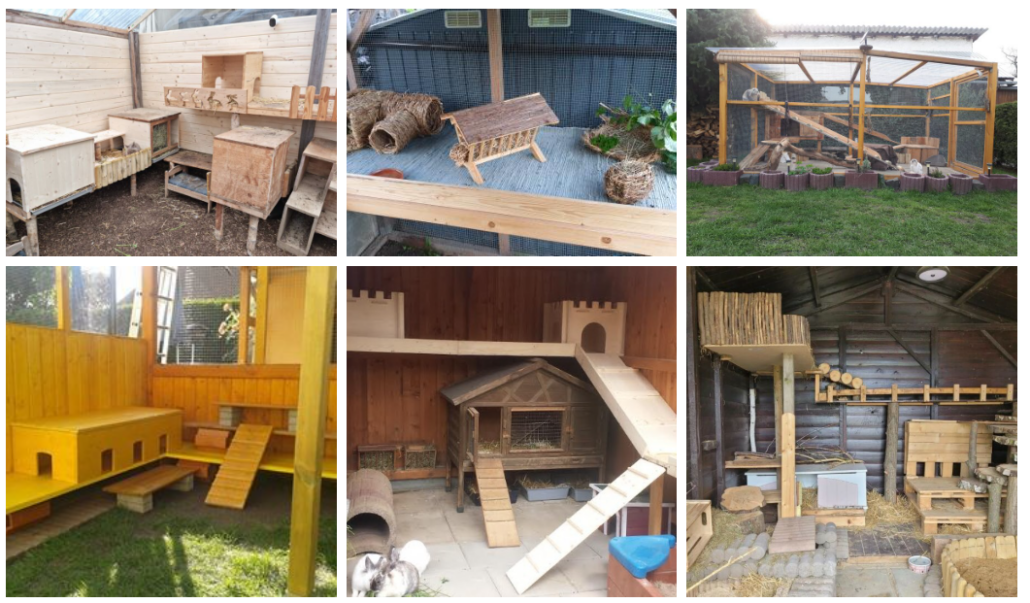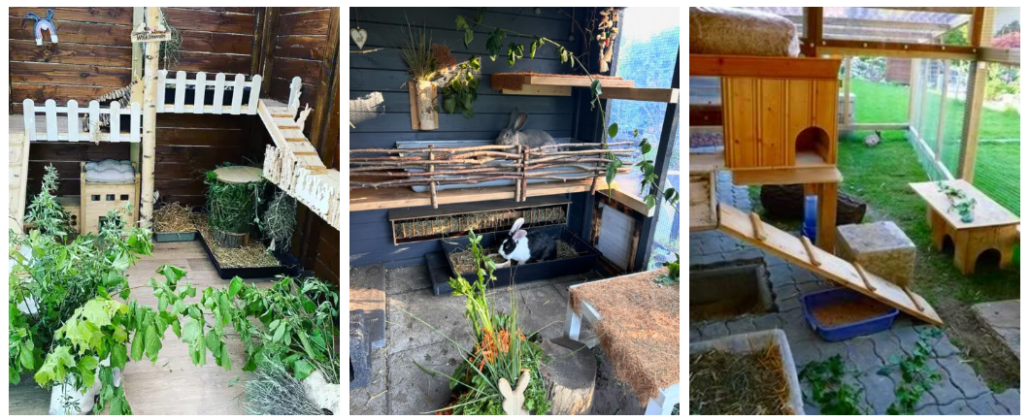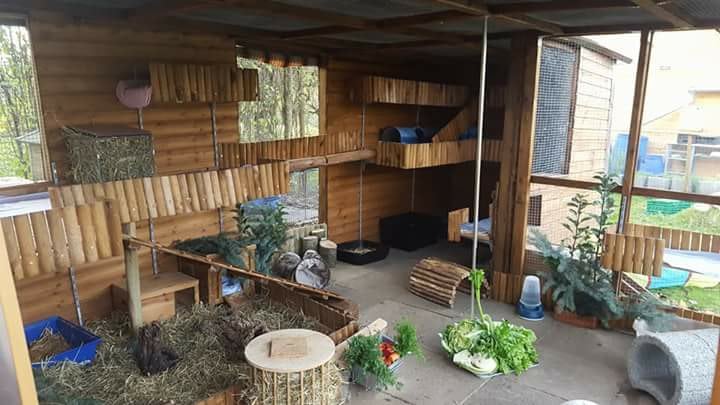

What should you pay attention to?
Before building an enclosure, it is worth carefully considering a few planning aspects. This helps ensure that the enclosure remains functional over the long term and is practical and comfortable in everyday use, both for people and for the animals.
Location: Where should the enclosure be built?
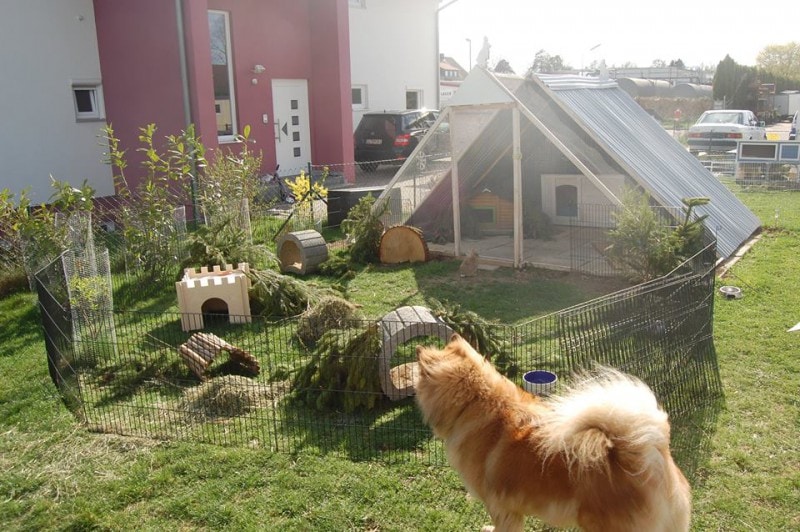
A rabbit enclosure should be easily visible from the house, for example from a kitchen or living room window. It is also advisable to place it close to the house, as this makes daily care much easier, especially during winter.
An ideal location offers both sunny areas and shaded spots. Natural shade from trees or shrubs is the best option. In winter, rabbits benefit from access to sunlight, while in summer shade is essential.
Visibility from the street may also be worth considering. Incidents involving animals are not uncommon. If it is not immediately obvious from outside that rabbits are present in the garden, the risk of problems may be reduced.
Size: How much space do rabbits need?
As a general rule: the more space, the better.
The minimum enclosure size depends on how much time the rabbits can spend exercising outside the enclosure (for example in a garden or a larger designated area). Regardless, rabbits should always have several square meters of space available.
For two rabbits:
If the rabbits have little or no exercise, at least 12–15 m² of space is recommended.
For each additional rabbit: + 2 m²
Exercise = free access to a very large and varied area.
Whenever possible, rabbits should be given more space. These dimensions represent only the absolute minimum.
| Number of Rabbits | Minimum Size |
|---|---|
| Two rabbits | 6 m² floor area (e.g. 2 × 3 m) |
| Three rabbits | 7.2 m² (e.g. 3.6 × 2 m) |
| Four rabbits | 8.4 m² (e.g. 4.2 × 2 m) |
| Five rabbits | 9.6 m² (e.g. 4.8 × 2 m) |
| Six rabbits | 10.8 m² (e.g. 5.4 × 2 m) |
| Seven rabbits | 12 m² (e.g. 2 × 6 m or 3 × 4 m) |
Ground Protection: Does the enclosure need to be secured from below?
Yes. A rabbit enclosure must have ground protection to prevent rabbits from digging out and escaping or predators from entering. The appropriate method depends on the ground conditions and the rabbits’ tendency to dig.
Common protection methods vary, but regular inspection of the ground is essential to maintain enclosure safety.
The following options are available:
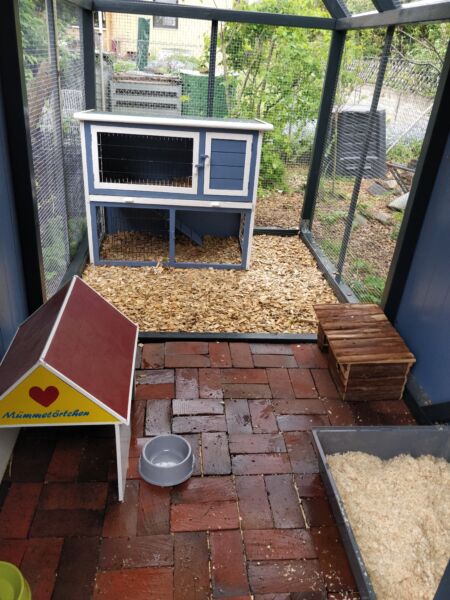
- Rabbit enclosure with a shelter house, bowl, and wooden bench inside.
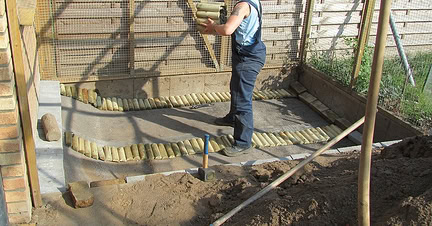
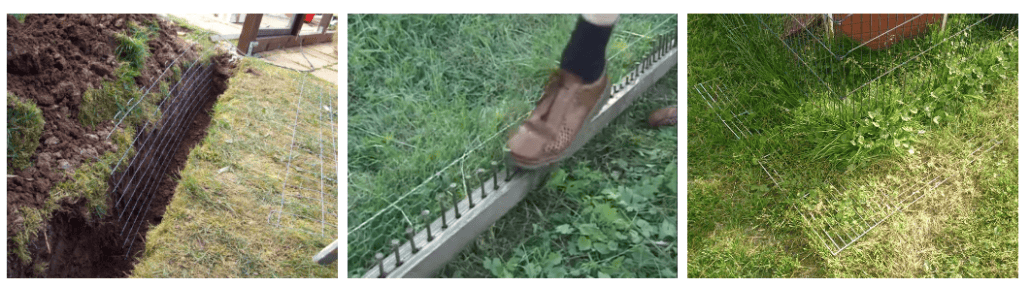
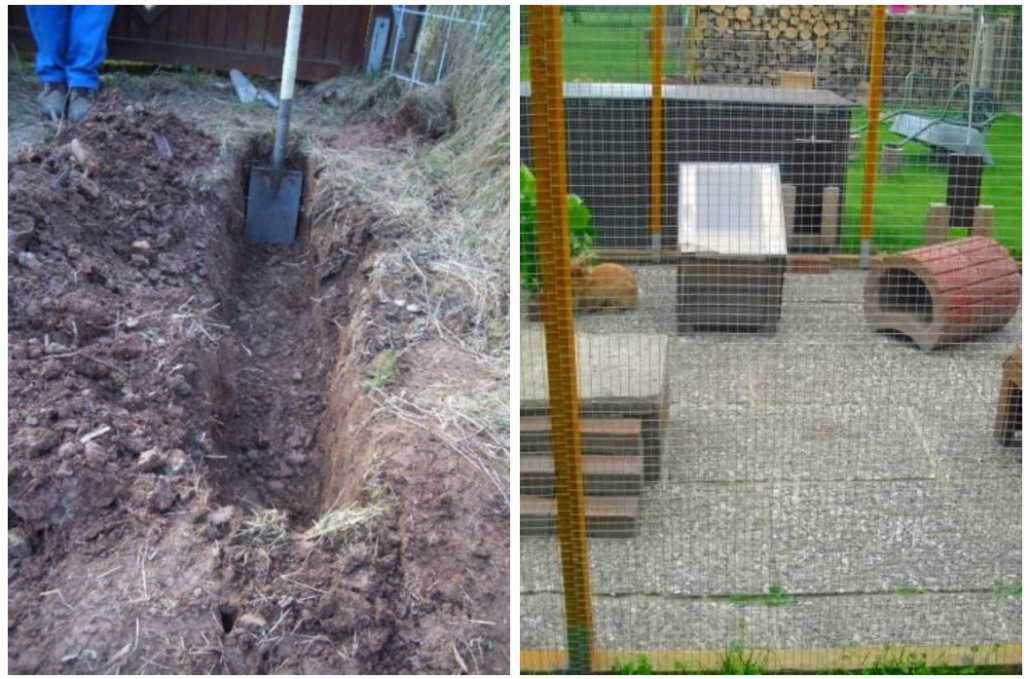
- Along the edges of the enclosure (depending on soil density), bury the enclosure wire at least 30–100 cm into the ground, or sink slabs to that depth. It is recommended not to place the lower enclosure beams directly on the ground (risk of mold/rot), but to keep them slightly elevated; the ground-protection mesh can then be pulled up to the beam. Important: With this type of protection, the rabbits’ burrows must be monitored constantly and closed if necessary.
- Lay slabs along the edges of the enclosure (inside or outside), each at least about 30 cm wide, so that an animal would have to dig further to get in or out. Important: Keep an eye on the rabbits’ burrows and close them if they get too close to the enclosure edge.
- Excavate the enclosure and secure it underneath with wire (covering the entire enclosure area), then spread the soil layer or the desired ground surface on top. This is only feasible for small enclosures and suitable soil conditions.
- Cover the entire enclosure with paving slabs or otherwise seal it (concrete, etc.). Paving slabs can often be obtained cheaply through classifieds if you collect them yourself.
Flooring: What type of ground is suitable?
Hygiene is crucial in a rabbit enclosure. Large enclosures are not always easy to maintain, so the choice of flooring directly affects daily cleaning effort.
In practice, solid, easy-to-clean surfaces are usually the most hygienic and easiest to maintain.
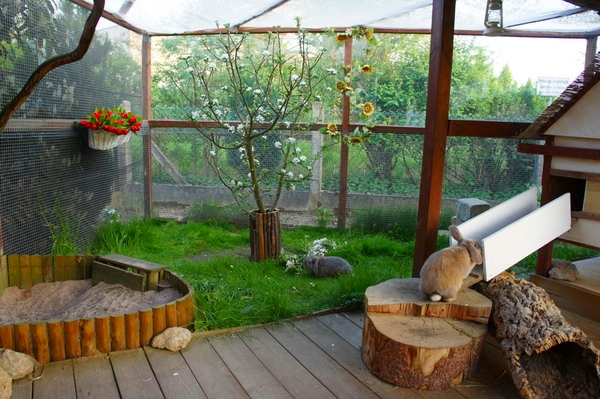
Digging Area
Rabbits enjoy digging, and many females in particular should not be kept without a suitable digging area. If the enclosure floor is paved or too hard, simple alternatives can be provided.
This allows rabbits to dig safely without compromising stability or hygiene.
Mesh: What type of mesh is safe?
Outdoor rabbits must be protected from predators such as martens and foxes. At the same time, the mesh must be strong enough to withstand the rabbits’ own gnawing. Not all mesh types on the market are suitable; many products sold as “rabbit mesh” are too weak.
A safe and suitable mesh must meet specific durability and stability requirements.
Regular inspection:
The enclosure should be checked frequently for weaknesses and damage.
Types of Mesh
• Hexagonal mesh (typical “rabbit mesh”):
Can be safe if the openings are small, but has a major weakness: even minor damage or rust can cause the mesh to progressively unravel. Thin wire and plastic-coated versions are usually too fragile. Requires very frequent checks and is generally not the safest option.
• Welded wire mesh (spot-welded):
The most recommended option. Durable, stable, and resistant. Localized damage does not compromise the entire structure. Common recommendations include 12 × 12 mm with 1 mm wire thickness, or up to 19 × 19 mm with thicker wire. It should always be galvanized and rigid.
• Plastic-coated mesh:
Often misleading, as the internal wire is usually very thin. Generally not considered safe.
• Rigid heavy-gauge wire panels:
Extremely strong and long-lasting. Slightly larger openings may be acceptable if the material cannot be bent.
Rabbit wire must be fixed correctly: attach it to the final mesh intersection, not to a protruding wire that does not form a closed mesh. After fixing, perform a strength test.
Inspection:
Every autumn, the enclosure should be thoroughly checked and any weak points repaired.
Additionally, a fine insect screen (for example metal mesh) can be installed over the welded wire mesh. This protects rabbits from insects, which can transmit diseases such as myxomatosis and cause flystrike.
Visual Barriers Along the Edges
Caution with wire panels: in panic situations, rabbits may fail to perceive them properly and collide with them. This can result in serious injury or death. To reduce this risk, it is advisable to install a wooden board approximately 20 cm high along the lower edges so rabbits can better perceive the boundary.
Upper Protection: Must enclosures be secured from above?
A rabbit enclosure must always be protected from above. Otherwise, foxes and martens can easily climb over the fence. However, this does not necessarily require a fully closed roof.
Possible solutions:
– Fully covered enclosure (for example with mesh or a solid roof). Especially recommended for small enclosures. Nets are not marten-proof; only very dense steel cable nets would be safe, but they are extremely expensive.
– Open-top enclosure, with a minimum fence height of about 2 m, plus an outward-angled top section at least 50 cm wide (approx. 30-degree angle), secured with electric fencing or smooth, non-grippable materials (plexiglass, metal, etc.).
Tip: Those planning an open-top enclosure may benefit from studying fixed cat fencing systems, which often include effective anti-climb solutions.
Door Security
Because incidents caused by people (animal cruelty, theft, releasing animals) do occur, it may be advisable to equip enclosure doors with locks.
Anchoring the Enclosure? Storm Protection?
Many enclosures must be secured to the ground to withstand storms. Strong winds can move or overturn lightweight structures. Enclosures with closed sides and large wind exposure require particularly stable ground fixing.
To secure the enclosure:
– Bolt it to a concrete base using metal brackets and anchors.
– Firmly secure the enclosure corners to the ground with screws.
– Or set the posts directly in concrete.
Side Height: How tall should the enclosure be?
Walk-in enclosures are the most practical (though more expensive) and should be slightly taller than a person’s height. They greatly simplify care and cleaning.
Lower enclosures (approx. 1 m high) are also possible, but the roof must be fully openable for convenient cleaning. Pyramid-shaped enclosures are another practical design.
Note: Depending on region, size and design, building permits may be required.
Materials
The enclosure frame can be built from sturdy wood such as beams and battens. Alternatively, existing structures (carports, greenhouse frames) may be adapted and covered with welded wire mesh.
Corners are typically joined with metal brackets, though direct screwing is also common. Metal plates are useful for extending wooden elements.
Heavy, stable enclosures usually do not require additional fixing.
Roof
Corrugated panels are commonly used. They should be intact, properly edged, and firmly screwed down. Metal panels are especially durable but more expensive.
Door
Doors require secure, predator-resistant latches.
Wood and Durability
Most wood types withstand rabbit teeth if sufficient gnawing material is provided. Otherwise, install mesh on the inside.
Moisture protection is critical. Avoid direct ground contact; elevate the structure or use paving slabs. Untreated wood deteriorates quickly.
Use only animal-safe protective coatings. Pine is inexpensive but less weather-resistant. Oak and larch are more durable. Construction battens are often a cost-effective choice.
Protection Against Wind, Snow and Rain
Rabbits require protection from moisture, wind, drafts, snow and rain. Even in poor weather, they must be able to move freely.
A roof should always be sloped. Some sides should be closed, especially weather-exposed ones. In winter, additional coverings may be used while maintaining ventilation.
Suitable side protection includes:
– Tarps or plastic sheets
– Transparent panels
– Wooden cladding
Do Not Build a Fair-Weather Enclosure
Most days are not warm and dry. Poorly planned enclosures quickly become problematic:
– Urine freezes, waste sticks, cleaning becomes difficult.
– Grass areas turn into mud.
– Dry zones become damp.
– Snow removal becomes necessary.
– Waste accumulates under snow.
– Cleaning may require working in rain or mud.
Many owners regret not having built a largely covered, walk-in enclosure with a solid, easy-to-clean floor from the beginning.