

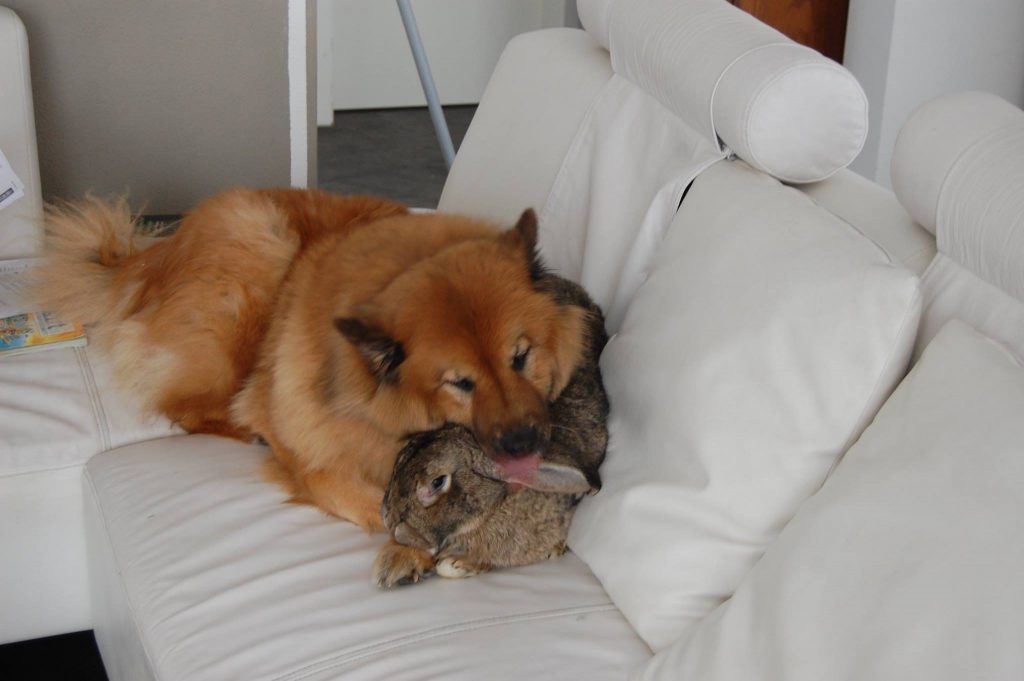
A harmonic life together with dogs, cats, and guinea pigs…
When it comes to keeping different kinds of animals under one roof, there are many different views among rabbit owners. Some refuse to keep predators and preys together; others think it’s just a matter of education, and still another has been keeping dogs and rabbits harmonically together for years.
Who is right, however? Can you keep rabbits with other animals? And if yes, with which ones and what do you have to keep in mind?
Keeping rabbits and guinea pigs together
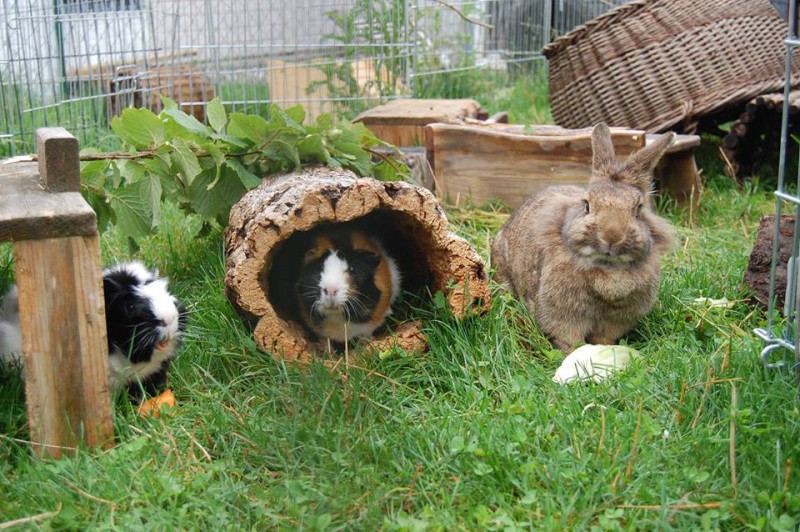
Due to a lack of knowledge, many pet shops incorrectly suggest to keep a rabbit and a guinea pig together. By doing so, both pets will be together alone, because not only do they come from different continents, they also speak different languages (hence can’t understand each other) and it is even possible that they hurt each other. “But they’re cuddling together and love each other so much”, some might say, and sometimes this is even true. We humans, for example, could be living together with a dog that we love, and cuddle, and play with. This dog, however, doesn’t understand our problems and woes; it is living a totally different life and is acting in a totally different way than we do. Even if we love this dog from the bottom of our hearts, we do need another human who understands and acts like us to talk about our experiences and Problems.

Professor Sachser has carried out an investigation about the keeping of rabbits and guinea pigs together:
The test setup was the following: There were two cages connected with each other. In the first test, there were two guinea pigs in each cage. In the second test, there was one rabbit in one cage and one guinea pig in the other. The guinea pig was able to go into the other cage with the rabbit or the guinea pig respectively through a tube, or to stay in its cage by itself. The result of the test was the following: The guinea pig which could choose between being alone and being with another guinea pig, spent most of the time with the other guinea pig. However, the guinea pig which could choose between being alone and being with another rabbit, chose to be alone most of the time. That shows quite clearly why you should always keep at least two rabbits and two guinea pigs together, as another conspecific is always something different than a completely different animal.
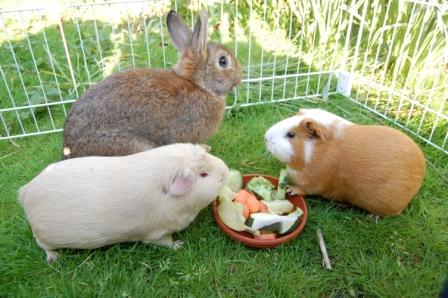
You can of course keep rabbits and guinea pigs together. Sometimes they’re just living side by side and don’t want to have anything to do with each other. Sometimes they’re using the other one as a warm place to sleep in the winter or they sniff at each other, groom each other etc. When you watch them you might notice that they’re moving in groups (rabbits together and guinea pigs together) when having a lot of space.

Something is fundamentally important, however! Guinea pigs as well as rabbits do need at least one more conspecific (so you have to keep at least two guinea pigs and two rabbits together), so that they have one of their kind that understands them and reacts to their social behaviour in the right way. See also: Keeping rabbits all alone.
How a coexistence can work out: Basically, a coexistence of rabbits and guinea pigs is only possible when they have a lot of space (from 10m² enclosure area upwards), so that they can avoid each other if they want to.
Furthermore, rabbits need elevated possibilities of retreat which guinea pigs can’t reach. The guinea pigs, however, need bigger houses with small entrances, in which they can retreat without being disturbed by the rabbits. Furthermore, guinea pigs should have many additional hiding places. The area has to meet the needs of both species.
Besides that, you have to keep in mind that, unlike rabbits, you can’t housetrain guinea pigs.
Should you have rabbits that show aggressions towards the guinea pigs, that are very active and are “overrunning” the guinea pigs thereby (young rabbits) or are defending their territory, the guinea pigs have to be kept separately so that they won’t be harmed.
“Almost all small pet animals are living in family groups by nature. Therefore, it is inevitable to keep a small family of at least two animals of the same species together when keeping them at home or outside. However, due to the different body and spoken languages, guinea pigs and rabbits do not understand each other. So, at least two of them should live together in a separate cage when both species want to be kept. The best constellation is a castrated male with one or more females. Couples of the same sex do often not get along very well with each other. Cages for small pet animals should always have enough individual places to hide for every single resident and should be wide and high enough for them to hop around and stand upright.”
German Association of Practising Veterinary Surgeons
Rabbits and dogs
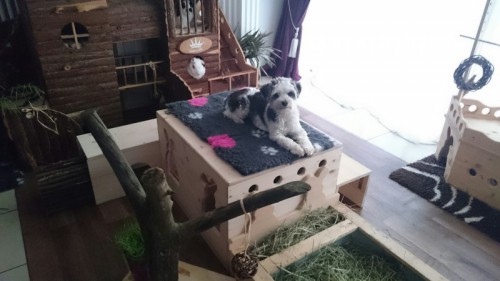
When a dog has grown up together with rabbits, it is normally no problem to accustom it with them. Nevertheless, you should keep an eye on your dog and set limits when it is behaving in a way that might frighten the rabbits. Especially with regard to hunting dogs, however, extra caution is required even when they have grown up together. It takes a lot of time, consistency and patience to get rabbits and dogs used to each other. The dog will accept the rabbit as a family member in the end. If you already have rabbits and get a dog afterwards, the dog often gets used to the rabbits quite well.

The most difficult case is when you already have a dog and get rabbits afterwards. This is especially the case with regard to hunting dogs. During the period of acclimatisation, the dog should not have access to the enclosure of the rabbits at first. However, it should have the opportunity to watch them through the enclosure bars until the rabbits get accustomed to the presence of the dog (take it slow!) and the dog loses its interest in the rabbits. After that, you can take the dog to the rabbits on a leash and later on a towline. When the dog knows its limits, has gotten used to the rabbits and the rabbits have gotten used to him, you can also let the towline drag. Eventually, the dog can move freely without the leash and in the end even without people being present. These are all very small partial steps, however. You can only go on to the next step when the dog is behaving absolutely correctly and poses no threat to the rabbits. Thus, a good coexistence of dogs and rabbits can be formed.
Rabbits and cats
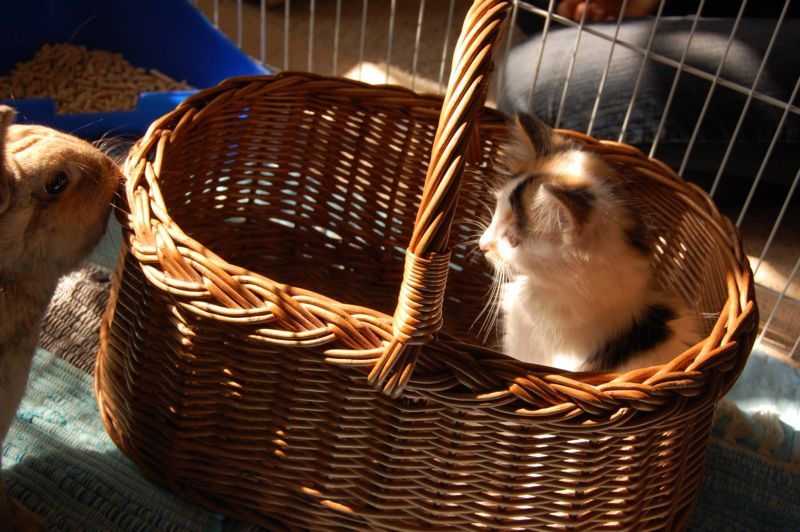
You often hear that cats can’t be trained. That is not quite right, however. It is true that cats do have their own will, but they can indeed be led into a certain direction. Young rabbits and baby rabbits belong to the predator-prey system of cats, so they shouldn’t be allowed into enclosures with small, young rabbits unless you are absolutely sure that the cat won’t do any harm to them (and even then you should supervise the cat in the beginning).
Things are different regarding grown-up rabbits. If you do not happen to have a monster cat (such cats are very rare by the way), it might be interested in the rabbits but won’t try to kill or attack them but rather want to play with them harmlessly.
Often cats also have great respect for the rabbits (see picture) when they come running towards them and attacking them with their paws. The first encounters with the rabbits should be supervised carefully and the cat should be put in its place, if necessary. Cats learn quite fast that the rabbits belong to the family and find them interesting, but they can’t really decide whether they should run away from them or hunt them. When the rabbits run away, the cats often chase them, but when the rabbits turn and face them, the cats run away in fear.
Often the animals even play with each other or tease each other (the cat chases the rabbit, the rabbit chases the cat by turns).
If you want to let your rabbits run free in your garden, you should watch the cats living in the neighbourhood in the beginning. It rarely happens that there are real wild tomcats living nearby that could pose a threat to your rabbits.
Rabbits and chickens/ducks in one enclosure
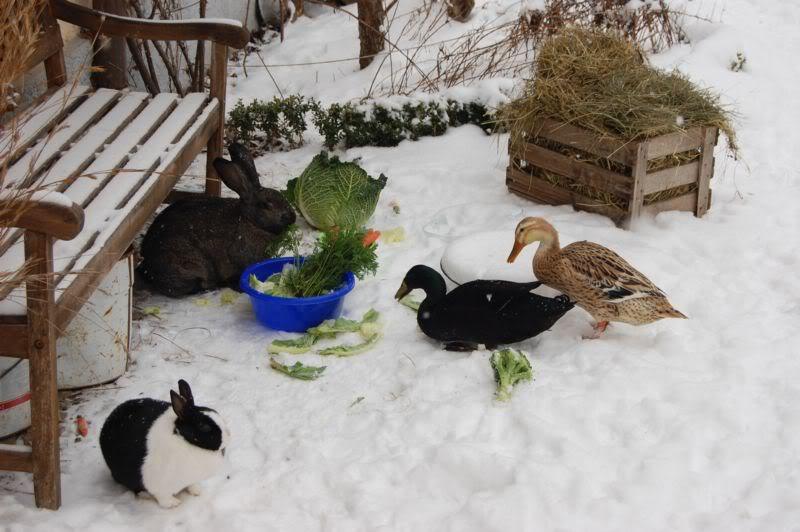
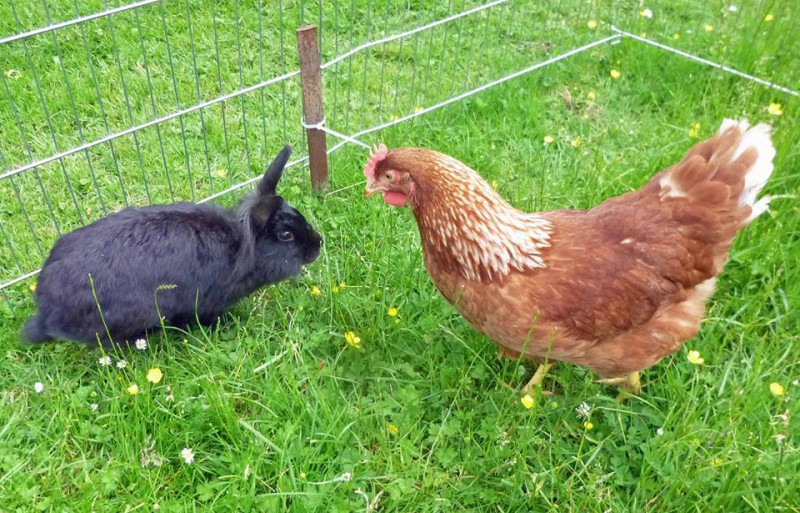
Chickens and ducks normally have no problem with rabbits. It is possible that a chicken might try to peck at the rabbits from time to time but injuries are seldom if ever. You should keep in mind, however, that birds can infect our rabbits with coccidia, especially when they are living together quite closely. Therefore, chickens and ducks should regularly be treated preventively if need be.
Translated by Sarah Schmidt