
Loading
  • Link to Instagram
How to rabbit
  • Home
  • Getting a Rabbit
    • Before You Get Rabbits
      • Rabbit Care for Beginners
      • Rabbit Care in 15 Minutes
      • How Much Do Rabbits Cost?
      • Lop Rabbits: Health & Welfare Concerns
      • Rabbit Lifespan: How Long Do Rabbits Live?
    • Choosing & Bringing Home Rabbits
      • Bringing a Rabbit Home
      • Sexing Rabbits: Male or Female?
      • Neutering Male Rabbits
      • Rabbits and Other Pets
      • Rabbit Adoption Contract
  • Housing
    • Outdoor Housing
      • Winter Care for Rabbits
      • Keeping Rabbits in the Garden
      • Building an Outdoor Rabbit Enclosure
      • Overwintering Rabbits
      • Outdoor Rabbit Run Ideas
    • Indoor Housing
      • Rabbit Litter Training Guide
      • Setting Up a Rabbit Room
      • Vitamin D for Indoor Rabbits
      • Keeping Rabbits Indoors
      • Indoor Rabbit Housing Ideas
      • Keeping Rabbits Cool in Summer
    • Balcony Housing
      • Keeping Rabbits on a Balcony
      • Rabbit-Friendly Balcony
  • Feeding
    • Foods for Rabbits
      • Grass & Meadow Plants
      • Pellets for Rabbits
      • Vegetables
      • Culinary herbs
      • Fruits for rabbits
      • Water & Drinking
    • Feeding Guidelines
      • Feeding Guidelines
      • Common Feeding Mistakes
      • Rabbit Feeding Myths
      • How to Feed a Baby Rabbit
    • Feeding tips
      • How to Transition a Rabbit to a New Diet Safely
      • Winter Diet for Rabbits
      • Nutrition for Young Rabbits
      • Diet Changes in Young Rabbits
    • Nutrition Basics
      • What can rabbits eat?
      • Types of Rabbit Diets
      • Is Hay the Main Food for Rabbits?
      • Tooth Wear & Dental Health
      • Crude Fiber & Carbohydrates
      • Secondary Plant Compounds
      • Food selection
      • Between Scarcity and Abundance
      • Rabbit Digestion
      • Wild Rabbit Nutrition
    • Foraging & Plant Identification
      • Foraging Meadows for Beginners
      • Identifying Coniferous Trees
      • Highly toxic plants
    • Food & Plant Lists
      • Safe Branches for Rabbits
      • Best Vegetables for Rabbits
      • Wild Grasses for Rabbits
      • Aromatic Herbs for Rabbits
      • Foraging & Plant Identification
      • Garden plant list
      • Fruit list
  • Companionship & Bonding
    • Rabbit Bonding
    • After a Rabbit Dies: Should the Other Rabbit Live Alone?
    • Can Rabbits Live Alone?
    • Choosing the Right Rabbit Companion
    • Rabbit Bonding Methods
    • Common Bonding Mistakes
    • Bonding of Young Rabbits
    • Keeping Rabbits in Large Groups
    • Hierarchy Fights & Bullying
    • Bonding Disabled or Ill Rabbits
    • Rabbit Socialization
  • Behavior
    • Handling Rabbits
    • Common Behaviors & Problems
      • Rabbits that don’t get along
      • Handling traumatized rabbits
      • Nibbling & Chewing
      • Digging
      • Humping
      • Kicking, Scratching & Wriggling
      • Biting & Aggressive Behavior
    • Body Language & Senses
      • Rabbit Senses
  • Health
    • General Health
      • Is My Rabbit Sick?
      • Recognizing Pain in Rabbits
      • Sudden Death in Rabbits: Possible Causes
      • Rabbit Health Myths
    • Digestive Disorders
      • Gastric Dilatation in Rabbits
      • Bloating in Rabbits
      • Hairballs & Constipation
      • Rabbit Diarrhea & Mushy Poop
      • Stomach Overload
      • Coccidia in Rabbits
      • Yeast in Rabbits
      • Worms in Rabbits
      • Underweight & Overweight Rabbits
      • Megacolon Syndrome
      • Bacterial Enteritis
      • Appendicitis in Rabbits
    • Skin, Fur & Parasites
      • Molting
      • Flystrike in Rabbits (Myiasis)
      • Mites, Ticks, Fleas & Other Parasites
      • Ear Mites
      • Skin Fungus
      • Wounds & Bite Wounds
      • Abscesses
      • When Rabbits Lick Themselves Raw
      • Sore Hocks in Rabbits
      • Injection Necrosis
      • Tumors & Cancer in Rabbits
      • Skin Inflammation
    • Infectious Diseases
      • Rabbit Snuffles
      • E. cuniculi in Rabbits
      • Rabbit Hemorrhagic Disease (RHD)
      • Myxomatosis
      • Ear Infection
      • Rabbit Syphilis
      • Tularemia (Rabbit Fever)
      • Tetanus
      • Toxoplasmosis
      • Listeriosis
      • Rodentiosis
      • Herpesviruses in rabbits
    • Internal & Organ Diseases
      • Liver Diseases
        • Liver Lobe Torsion
      • Cystitis
      • Bladder Sludge & Bladder Stones
      • Kidney Failure
      • Sex & Neutering
      • Uterine Diseases
      • Heart Diseases
      • Thyroid Diseases
      • Heatstroke in Rabbits
      • Stroke in rabbits
      • Schock
      • Hormonal Disorders
    • Other Health Conditions
      • Floppy Rabbit Syndrome
      • Dental Diseases
        • Jaw Abscesses
        • Nutrition for Dental Disease
      • Eye Diseases in Rabbits
        • Watery Eyes
      • Joint Diseases
      • Bone Fractures & Accidents
      • Cramps & Seizures
      • TThymoma, Lymphoma & Other Tumors
      • Poisoning in Rabbits
      • Mold & Mycotoxins
  • Care
    • Rabbit Poop & Urine: What It Means
    • Housing for Disabled & Elderly Rabbits
    • Wheelchairs & Mobility Support for Rabbits
    • Rabbit Health Check
    • Dirty Bottom in Rabbits
    • Why Does My Rabbit Pee & Poop Everywhere?
    • Saying Goodbye to a Rabbit
  • Offspring
    • Breeding that causes animal suffering
  • Service
    • News
    • About Us
    • Legal Disclosure
    • Privacy Policy
  • Click to open the search input field Click to open the search input field Search
  • Menu Menu

Living on the balcony

Open balcony-keeping.

No matter if summer or winter: The balcony is a good place to create a little habitat for your rabbits. Due to the lack of space, no own garden or any other reason the balcony is a good solution, especially for people who live in the city and cannot keep rabbits indoors.
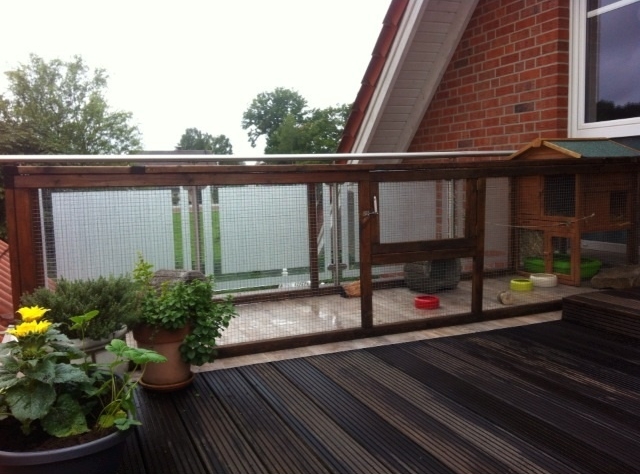
A secure balcony enclosure.

It is important, that rabbits have enough space on the balcony. They should have the opportunity to use the entire space day and night – unless you have a balcony large enough to fence off at least 6m².

Examples of balcony-keeping with pictures: Balcony picture collection

Contents

  • Proper furnishing
  • Safety on the balcony
  • Caution, heat!
  • Caution, cold!
  • A safe balcony railing
  • Safe from predators

Proper furnishing

Run on the balcony.

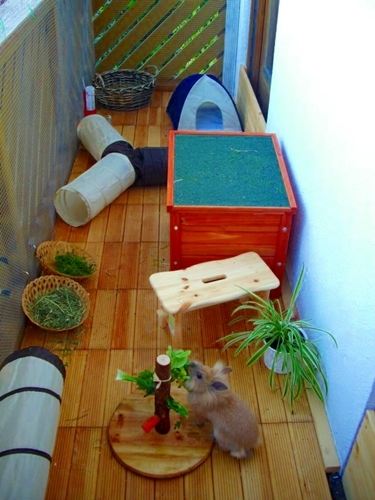
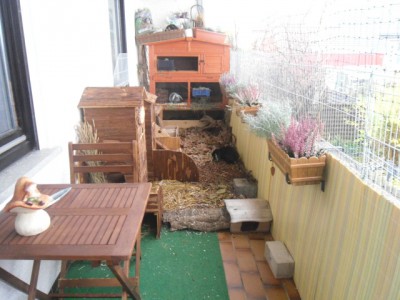
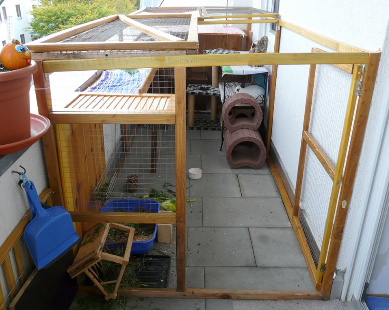
To feel comfortable on your balcony, your rabbits need appropriate furnishing. Just like in outdoor-keeping you will need a hutch for shelter (needs to be draft- and rainproof). Rabbits also need a roofed area. If your balcony is not (partly) roofed, you have to build some sort of roofing. This will also be the area where you can place the food. Additional to the hutch, you can add little pet cabins and houses as well as other elevated areas. Closed cat toilets in the corners can be used as rabbit toilets for house trained rabbits. The rabbits need suitable furniture, so they won’t get bored.

The ground can (if it is a sensitive material) be protected with cheap PVC floor coating. This needs to be fixed with skirting board around the edges, so the rabbits won’t be able to nibble it off. Choose a rough surface PVC floor so the rabbits don’t slip. Concrete floor is also suitable for them. Even though it looks rather unhomely, they seem to like it. Carpet or artificial lawn are also an option; however, it can sometimes lead to the rabbits rubbing the feet sore.

Safety on the balcony

To protect the rabbits from potential dangers, the balcony-keeping should be well planned.

Caution, heat!
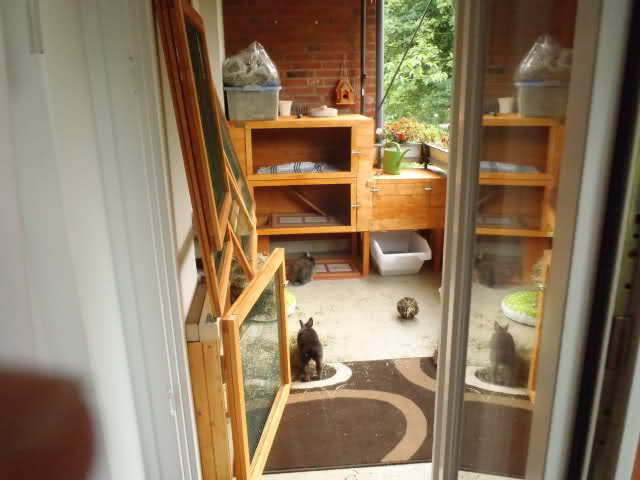
Enclosure elements mounted on the exterior wall of the house can be folded down. The accessible balcony is then secured against predators.

In summer it is necessary to watch the temperature. Especially on south-oriented balconies, it can get unbearably hot at midday. Shadowy places are essential for rabbits, so they are not exposed to heat. Otherwise they can suffer from a heat stroke. However, on many balconies (especially on small or closed ones) heat will gather so much – even in the shadow – that rabbits cannot live there. Balconies not facing south are therefore better suited. But even then, there have to be precautions against the heat. Wet towels hung over branches, cool pavement slabs, bottles with frozen water or cooling fans (aligned so that rabbits can also avoid the draft) are adequate measures to make summer easier for them.

Caution, cold!
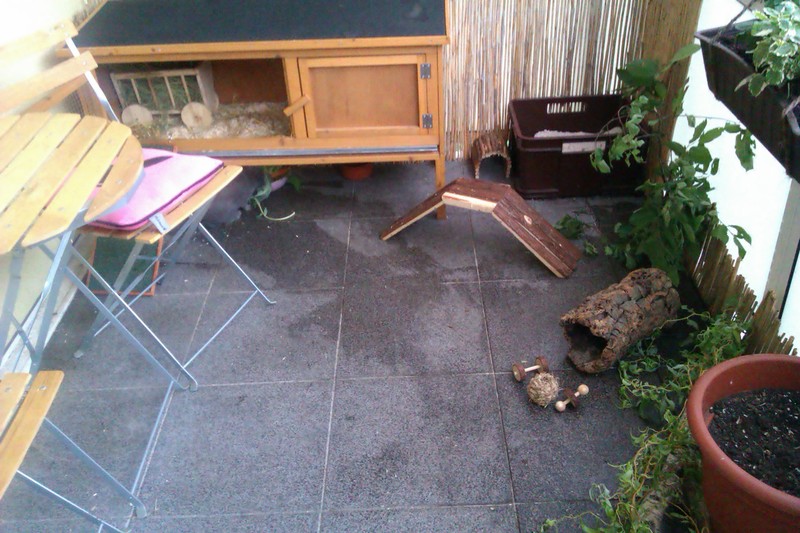
Open balcony-keeping.

In cold seasons, the same precautions should be taken as in the winter-outdoor-keeping. You can find the information here on this page.

A safe balcony railing
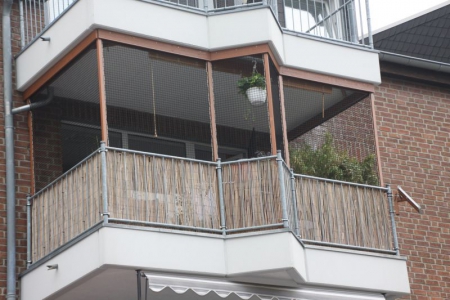
Rabbits fit through the tiniest cracks. If they can fit the head through, they can fit the rest of the body, too. Therefore, the railing might have to be secured with elements of metal run cages, wire mesh or wooden boards. A fall from a couple of meters is usually deadly for a rabbits. The enclosure should also be high enough, so that no rabbit can jump over. 1,20m is usually enough if there are no elevated spots near the railing.

Safe from predators

Should there be trees, cat ladders, climbing trellis or other things that could make the balcony accessible (martens can leap up to two meters), it is necessary to secure the balcony from above as well. Even a very rough exterior wall of the house can be climbable for some predators – smooth exterior walls are not climbable. Balconies that are close to the ground or terraces need to be secured as well. Downspouts can be secured with a gutter brush. Make sure that there is absolutely no way for predators to get onto your balcony. There might also be a tree near your roof from which they could get onto the roof and on your balcony.
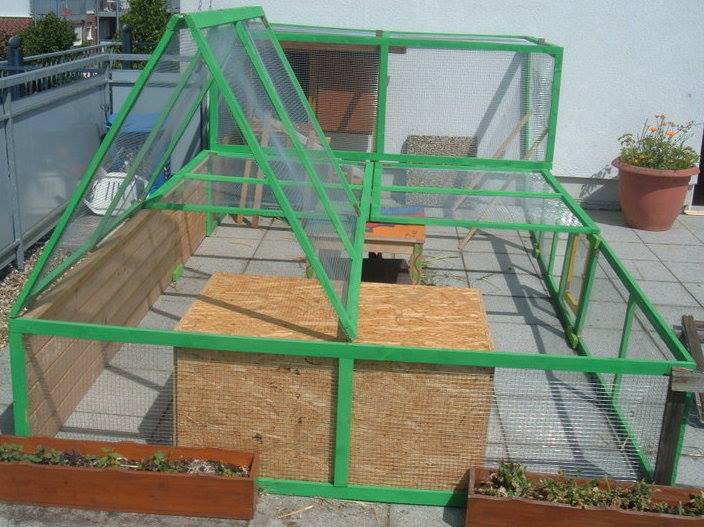
An enclosure on the roof deck.

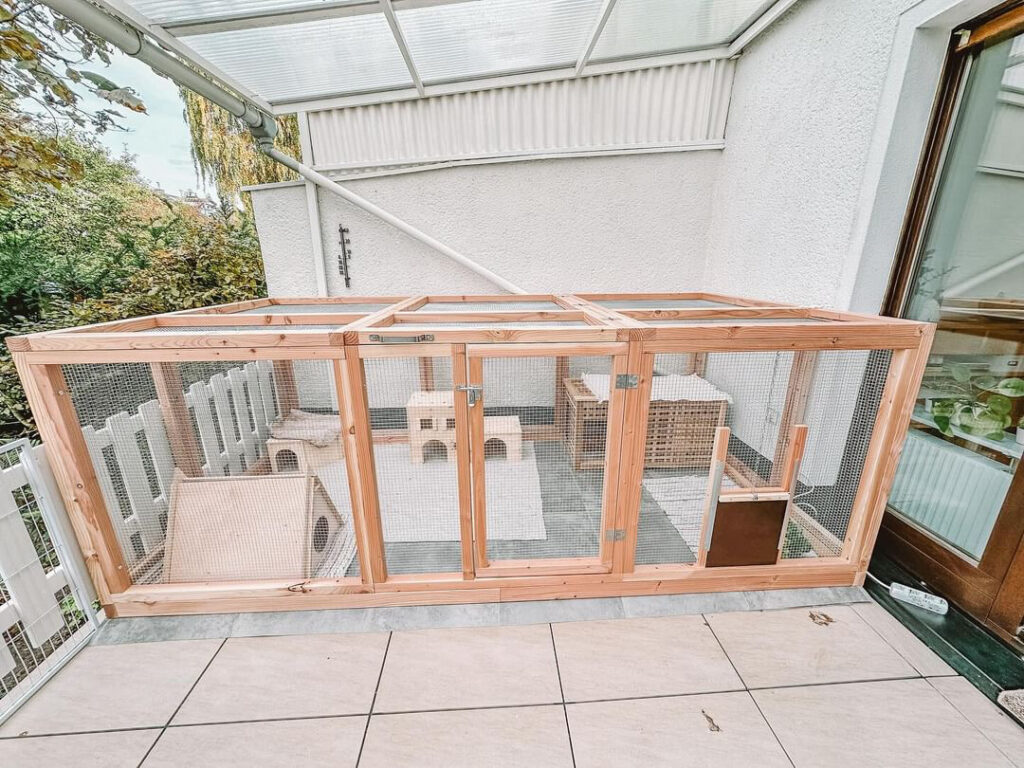
It is possible to build a fully closed enclosure onto the balcony. It should be about 1m in height and secured with wire mash all around.

It might be easier, however, to attach hinged enclosure elements to the exterior wall of the house, so that they can be folded over and rest on the handrail of the balcony. When you feed the rabbits or clean the enclosure you can simply lift the top off and the balcony is accessible again.

Many rabbit owners use cat protection nets for their balconies. However, they don’t keep away small predators such as martens.

When you are buying the materials make sure that you consider it to be safe against martens! Many wire mashes or grids are not safe.

Translation: Nina Fromme
Who Is Behind How to rabbit?

Veterinarian Viola Schillinger
Who Is Behind How to Rabbit? Viola Schillinger is a veterinarian who has kept rabbits since childhood and has dedicated much of her professional life to improving their health, welfare, and living conditions. Decades of rabbit keeping, intensive observation, and professional study have given her extensive experience in rabbit health, nutrition, behavior, and species-appropriate husbandry. She shares her knowledge through television appearances, webinars, podcasts, radio programs, articles, and books. In 2008, Viola founded Kaninchenwiese.de, which has grown into a leading German-language resource for rabbit care and health, reaching around 500,000 visitors per month. How to Rabbit brings this knowledge to an international English-speaking audience. The English content is translated and adapted by Erika Kühne Escobar and medically reviewed by Viola Schillinger.

Rabbits need space…


How to rabbit…

…is a guide for the appropriate keeping, nutrition and care of rabbits.

Search

Search Search

Never alone


Last Changes

  • Neutering Male Rabbits 2. October 2026
  • Cookie Policy (EU) 7. September 2026
  • Care 26. August 2026
  • Fruit list 27. September 2026
  • Highly toxic plants 30. July 2026
© Copyright - How to rabbit 2024 - Enfold Theme by Kriesi
  • Link to Instagram
Scroll to top Scroll to top Scroll to top