
Enteritis and Enterocolitis
Other terms: Mucoid enteritis, enterocolitis, enzootic enteropathy, rabbit epizootic enteropathy (REE), Clostridium infection, E. coli, Klebsiella variicola, intestinal paralysis, proctitis
What is enterocolitis, and what is enteritis?
The word enterocolitis is composed of the terms enteritis (inflammation of the intestines) and colon (large intestine) and refers to an inflammation of the mucous membrane in the colon of rabbits. Enteritis, on the other hand, is the general term for an inflammation of the intestines. In most cases, when these terms are used, they specifically refer to bacterial enteritis, as this can be contagious and often occurs in an epidemic form in breeding operations.
Enteritis and enterocolitis are multifactorial diseases, which usually only occur when unfavorable feeding, housing, and hygiene conditions meet a weakened immune system. For this reason, they are of little relevance in pet rabbit care, and if they do occur, they typically affect weakened individual rabbits, particularly in poor housing systems. With proper care, these conditions appear only in individual rabbits with a very poor health status. However, in breeding and meat production facilities, they are a major problem and can occur in an epidemic form. Weanlings are particularly affected.
An exception is intestinal inflammation caused by the bacterium Klebsiella variicola, which can lead to severe symptoms even in healthy, young rabbits, often misdiagnosed as gastric dilation.
Symptoms: How to recognize enteritis or enterocolitis?
The disease progresses in phases, and typically the following sequence occurs, although the phases may be mixed up:
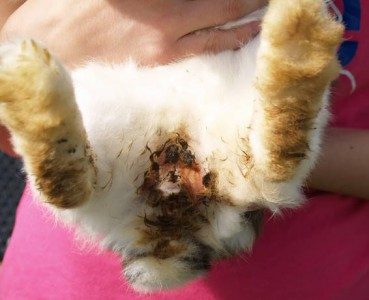
- Phase 1: Diarrhea and weight loss, usually with watery, foul-smelling (rotten odor) or jelly-like stool consistency. In cases of E. coli infection, diarrhea is typically the only symptom, while Clostridia cause blockages in the cecum. Klebsiella variicola usually causes loss of appetite due to cecal inflammation.
- Phase 2: Reduced food intake, sometimes leading to complete cessation of eating, and withdrawn behavior (apathy).
- Phase 3: Constipation, loss of appetite, and apathy (due to paralysis of the intestinal wall, which prevents the further movement of food, and the veterinarian will initially feel a sticky mass, later a hard food bolus).
- Phase 4: Fluid loss leads to dehydration, which causes circulatory failure, potentially resulting in breathing difficulties and death.
What promotes enteritis and enterocolitis?
- Parasite infestations, especially coccidia, but also worms. These can be detected through a stool sample and must be treated promptly.
- Poor housing conditions, such as pen housing, solitary confinement, and lack of movement. Movement keeps digestion healthy and active, as rabbits have very little peristalsis.
- Poor stable hygiene, which allows parasites and bacteria to multiply effectively.
- Low-fiber, non-species-appropriate, protein-rich diets that favor parasites in the intestines and provide an optimal breeding ground for bacteria. This includes the feeding of grains, dry food, feed pellets, hard bread, and large amounts of fruit.
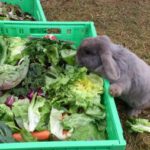
- Enterocolitis can be prevented by providing a fiber-rich diet consisting of fresh food and hay. The ideal diet is one made up of 100% green food (grass, leafy vegetables, herbs, twigs).
- Dietary changes (especially switching to low-fiber, protein-rich food, finely ground food, or improper water supply).
- A poor general condition of the animals or other illnesses that weaken them can also lead to enterocolitis in individual animals, even in good housing systems. In such cases, underlying conditions should be identified and treated.
- Young animals are more susceptible, especially during the weaning phase. They should be nursed for a long period and weaned with green feeding. Young rabbits cannot digest starch from dry food, and low-fiber foods promote the growth of harmful bacteria and parasites.
- The administration of certain antibiotics can trigger enterocolitis (penicillin, lincomycin, ampicillin, amoxicillin, cephalosporins, clindamycin, erythromycin).
Heat: Higher temperatures can cause the cecal flora to become imbalanced.
Triggers
Stress is generally the direct trigger. This can be caused by situations such as group introductions, fights within the group, frequent lifting and “cuddling,” a change in the environment, etc. After a stressful event, the contents of the cecum become more alkaline, which affects the entire intestinal environment. This, in turn, influences the gut flora (bacteria), within which harmful bacteria (e.g., Escherichia coli, Klebsiella variicola, Corynebacterium, Pasteurella spp., or Clostridium spp.) can proliferate rapidly.
Attention: The symptoms appear with a delay after the triggering event, often not until a week later!
How can it be determined that it is enteritis or enterocolitis?
The first step is to examine a stool sample. In conjunction with the general condition, typical symptoms, and a general examination, this helps to establish a presumptive diagnosis. If an animal has already died, an autopsy is recommended to provide certainty.
How is enteritis or enterocolitis treated?
The treatment for bacterial enteritis is sometimes delayed because the animals become very ill very quickly. They need to be intensively cared for in the hospital. However, antibiotics can at least prevent the infection of other animals.
Treatment of possible intestinal parasites (coccidia and worms):
- For the treatment of coccidia, Baycox should not be used, as it is very poorly tolerated in young rabbits and weakened adult rabbits. There are well-tolerated alternatives, such as Vecoxan.
- In acute cases, or depending on the previous bacteriological findings from the stock (e.g., C. perfringens, E. coli, streptococci, or Klebsiella), the veterinarian will administer an effective antibiotic. Partner animals must also be treated. Enrofloxacin is commonly used.
- Warm full-electrolyte infusions are used to stabilize the fluid and electrolyte balance and to dissolve the cecal contents.
- Possibly probiotics/prebiotics.
- Possibly lactulose.
- Vitamin B complex.
- Antispasmodics (e.g., dimethicone, Sab Simplex, etc.).
- Pain relievers (e.g., Novalgin).
- Something should be given to address nausea and to promote gastrointestinal motility. Metoclopramide (MCP 0.2-1 mg/kg, 1-3 times daily, caution: MCP should not be given for more than three days, and if necessary, it should be gradually reduced!). Its effectiveness is not scientifically proven, while cisapride unfortunately does not work in rabbits. The effectiveness of lidocaine infusions (100 µg/kg/min intravenously over two days) and mirtazapine (3 mg/kg, once daily) has been proven.
- Adjustment of housing, hygiene, and feeding conditions is necessary.
- A specific vaccine against toxins from Clostridium perfringens Type A has been developed, but it is currently unavailable.
Sources include:
Amici, A., Canganella, F., & Bevilacqua, L. (1998): Effects of high ambient temperature in rabbits: metabolic changes, caecal fermentation and bacterial flora. World Rabbit Science, 6(3-4), 319-324.
Anonymous: Die Darmlähmung beim Kaninchen
Mukoide Enteritis – Enterocolitis – ME – Rabbit Epizootic Enteropathie – REE [http://www.kaninchenwissen.de/knowledge/kb_show.php?id=12, 11.07.17]
Bryskier A, Doll J, Labro MT, Andrieu J. (1981): Role of Clostridium and its toxin in pseudo-membranous colitis. Ann Biol Clin (Paris). 39(1):1-8.
Gabrisch, K., Zwart, P. (2005): Krankheiten der Heimtiere. Hannover: Schlütersche, S. 28.
IDT Biologika GmbH: Der weltweit erste Impfstoff gegen Enterocolitis ist da!
Klausing, H. K.: Enterocolitis: Vorbeugen durch systematische Kaninchenernährung? [http://www.klausing.com/futterdoc/Kaninchen/Kaninchen1_Fachartikel/kaninchen1_fachartikel.htm, 11.07.17]
Lang, C., Greißl, S., Dinges, J., & Hoy, S. (2010): Untersuchungen zum Futteraufnahmeverhalten wachsender Kaninchen.
Praag, van. E.: Darmkrankheiten und bakterielle Enteritis bei Kaninchen [http://www.medirabbit.com/GE/GI_diseases/Bacterial/Enteri/Enteritis_ge.htm, 11.07.17]
Rossi (1999): Enterocolitis: Erste Erfahrungen aus Deutschland [http://www.kaninchenzucht.de/en_rossi.htm, 11.07.17]
Schlolaut, W. (2008): Das Für und Wider verschiedener Vorbeugemaßnahmen. Ansteckende Darmerkrankungen des Hauskaninchens. Kaninchenzeitung
Scholz, F. (): Enterocolitis der Kaninchen