

Heart Diseases
Heart diseases typically occur from around the age of 5.5 years, though they can appear earlier in larger breeds.
Causes
- High-carbohydrate diet: Leads to cardiomyopathy after 4–5 years.
- Infections caused by bacteria, viruses, etc.: Examples include encephalitozoonosis (EC), Staphylococci, Salmonella, Clostridia, rabbit snuffles (Pasteurellosis), coronavirus, and others.
- Dry and overly calcium-rich diet: Results in high blood calcium levels, which can lead to aortic calcification (arteriosclerosis).
- Vitamin E and selenium deficiency: A high intake protects against heart diseases.
- Vitamin D deficiency: A high intake offers protection against heart diseases.
- Breed predisposition:
- German Giant, New Zealand, and nearly all other meat rabbit breeds (prone to DCMP and arteriosclerosis).
- Dutch, Dwarf Lop.
- Study findings: Domestic rabbits were found to have a 37.5% lower heart weight compared to wild rabbits.
- Obesity
- Stress and lack of exercise
- Aging: Fatigue of the heart muscle.
Symptoms
Heart diseases in rabbits are usually detected very late or even too late because the initial symptoms are subtle. The first noticeable sign is often that affected rabbits do not play exuberantly, perform joyful jumps, etc., but appear “calm” compared to peers and become exhausted after activity.
Common Symptoms
- Reluctance to move: The rabbit moves less.
- Reduced appetite, weight loss, loss of appetite.
- Quick fatigue, poor condition: The rabbit seems exhausted and breathes heavily even after small efforts.
- Bloating/gas accumulation.
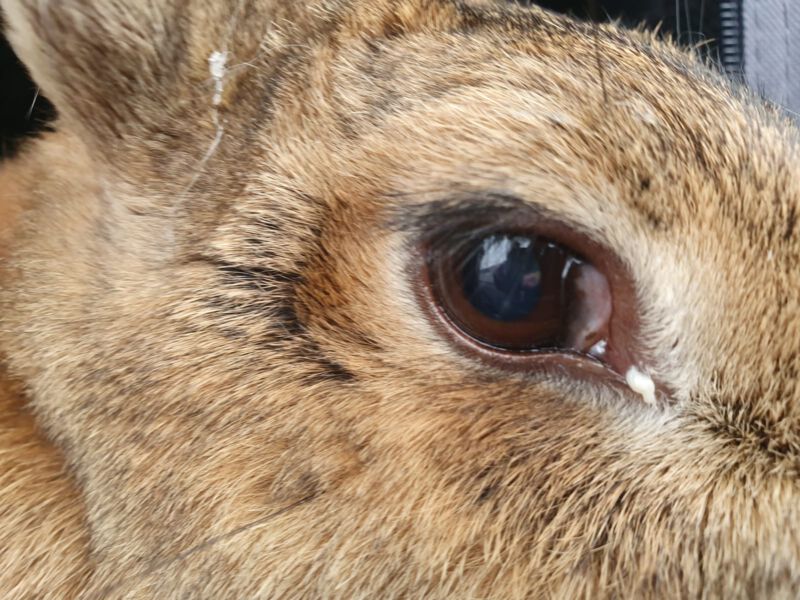
- (Intermittently) protruded nictitating membrane: Often noticeable during heat or stress.
- Bulging or protruding eyes.
- Movement disorders: Unsteady gait, seizures, coordination problems, etc.
- Heart murmurs: Rattling sounds, especially during stress.
- Weakness.
- Gas accumulation (bloating).
- Nonspecific symptoms: Many rabbits stop eating without any apparent cause.
Acute Signs of Heart Failure
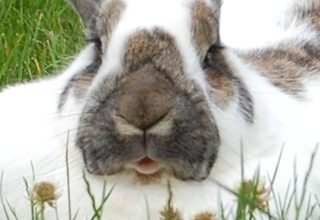
- Shortness of breath: Severe flank breathing, pronounced nasal breathing (nasal flaring), open mouth (due to fluid in the lungs/pulmonary edema).
- Rapid heartbeat: A healthy rabbit’s resting heart rate is typically between 140 to 180 beats per minute, while under stress, it can exceed 300 beats per minute (more than five beats per second).
- Open mouth: Often a sign of difficulty breathing.
- Raising the head to get better airflow: In the final stages, the rabbit may arch its neck excessively to try to breathe.
- Fluid in the abdomen/accumulation of fluid/edema (pleural effusion): Swelling caused by excess fluid buildup.
Case Study: Krümel, Mecklenburger Schecke (Large Rabbit), approx. 5.5 years old
At the age of 5, Krümel started showing signs of intermittent protrusion of the nictitating membrane (third eyelid) after New Year’s. This was treated with eye drops. Six months later, Krümel experienced acute heart failure overnight, resulting in fluid in the lungs and abdomen. Despite the serious condition, Krümel displayed calm behavior but continued eating.
Treatment and Response:
- Diuretic treatment with Dimazon and ACE inhibitors as long-term medication helped stabilize Krümel.
- A heart ultrasound conducted a few weeks later showed that Krümel’s heart was healthy, but there was an enlargement near the heart, which was putting pressure on it.
- The possible causes of this enlargement include an abscess, tumor, or thymoma.
Video Observation (6 hours after first diuretic injection):
- Severe flank breathing (indicating difficulty breathing).
- Heavy nasal breathing (nasal flaring).
- Fluid in the abdomen (visible hanging fluid buildup).
- Protruding nictitating membrane (third eyelid raised).
This case highlights how heart failure in rabbits can manifest through various symptoms, and how swift intervention can lead to stabilization, though the underlying cause (such as a tumor or abscess) still needs further investigation.
Diagnostics
When diagnosing heart diseases in rabbits, it’s essential to be aware that affected rabbits are highly stress-sensitive, and procedures such as radiographs (X-rays) can sometimes lead to fatal outcomes due to the stress involved.

Key Diagnostic Methods:
- Heart Ultrasound (Echocardiography): Typically, a heart ultrasound is the most reliable diagnostic tool for detecting heart issues in rabbits. It’s recommended to seek out a specialist, but often a knowledgeable veterinarian can refer you to one who performs heart ultrasounds in your area.
- Stethoscope Examination: Listening to heart and lung sounds can help detect irregularities like murmurs or abnormal rhythms.
- X-ray (Radiographs): X-rays are necessary to rule out differential diagnoses such as pneumonia, tumors, abscesses, thymomas, and other conditions that might put pressure on the heart.
- Blood Pressure Measurement: Measured with Doppler, as other blood pressure measurement methods (like HDO) do not work well for rabbits.
- VHS (Vertebral Heart Score): A measurement method used to assess the size of the heart relative to the vertebrae. Reference range: 6.8 – 8 (8.5) thoracic vertebrae (For rabbits under 1.6 kg: around 7.5 thoracic vertebrae).
- ECG (Electrocardiogram): Used to assess the heart’s electrical activity, helping diagnose arrhythmias or irregular heart rhythms.
- Pericardiocentesis: A diagnostic procedure involving the puncture of the pericardium (the heart’s protective membrane) to remove excess fluid for bacterial and cytological examination.
Key Points for Performing Diagnostics:
X-rays are crucial for excluding other conditions that could affect the heart, like lung infections, tumors, or abscesses.
Heart Ultrasound should be performed once the rabbit is stable, especially if the rabbit is in acute respiratory distress.
A heart ultrasound is typically done with the rabbit sitting upright, with the ultrasound probe placed from underneath to minimize stress. This approach is much more comfortable and less stressful for the rabbit.
Stabilization should be achieved before performing a heart ultrasound in cases of acute respiratory distress.
By combining these diagnostic methods, veterinarians can accurately assess the rabbit’s heart condition and develop an appropriate treatment plan.
Diagnoses in Rabbits with Heart Conditions
- Dilated Cardiomyopathy (DCM): A condition characterized by a dilated heart muscle, leading to impaired pumping function. This results in inefficient blood circulation and can cause heart failure.
- Hypertrophic Cardiomyopathy (HCM): In this condition, the heart muscle becomes thicker than normal, which impairs the heart’s ability to relax and fill with blood properly. This can lead to decreased heart efficiency and potential heart failure.
- Congestive Heart Failure (CHF): This is a pump dysfunction where the heart is unable to pump blood effectively, leading to fluid buildup in the lungs and other parts of the body (e.g., abdomen). It is often a result of DCM or HCM.
- Pericarditis: Inflammation of the pericardium (the protective sac surrounding the heart). This can lead to fluid buildup around the heart and restrict its movement.
- Myocarditis: Inflammation of the heart muscle, which can result from infections or immune responses. It impairs the heart’s ability to contract and pump blood.
- Endocarditis: Inflammation of the heart valves, often caused by bacterial infections. This can damage the valves, leading to heart dysfunction, especially in the mitral and tricuspid valves.
- Arteriosclerosis:Hardening or calcification of the arteries, which leads to reduced blood flow. This condition can affect the aorta and other large vessels, increasing the risk of heart failure.
- Heart Valve Insufficiency (Mitral and Tricuspid Valve Insufficiency) This occurs when the heart valves (typically the mitral or tricuspid valve) do not close properly, leading to blood leaking backward (regurgitation) and reduced efficiency of the heart’s pumping action.
Each of these conditions affects the heart’s ability to function properly, potentially leading to serious complications if not diagnosed and treated promptly.
Therapy
Some rabbits need to be stabilized before a heart ultrasound can be performed. The following therapy is used for stabilization:
- Oxygen
- Corticosteroids (in cases of acute shortness of breath—one of the few situations where corticosteroids can be used in rabbits!—only for short-term use)
- Diuretics (for fluid removal) if there is fluid in the lungs
The therapy should be as gentle as possible because forced medication administration can often do more harm than good. Try to find a more comfortable method of administering medication, such as hiding it in a tasty treat that the rabbit loves.
After thorough diagnostics, the veterinarian will prescribe appropriate medications (depending on the specific heart condition), such as:
- Diuretics (for fluid removal): If there is fluid in the lungs, Furosemide (Dimazon, Furotab, Lasix, etc.)
- ACE inhibitors (blood pressure reducers): Benazepril, Enalapril, Ramipril, Telmisartan, Imidapril (Prilium, Fortekor)
- Pimobendan (to increase heart pumping function): e.g., Vetmedin, Cardisure, Pimotab, Zelys
- Important: Dosage must be significantly higher than in dogs (e.g., Ozawa et al., 2022): 2mg/kg body weight
- Spironolactone (to reduce fibrosis): Cardalis
- Cardiac glycosides (Digoxin: increases heart contractility and delays electrical conduction): Lanicor tablets or injectable form
- Herbal preparations: such as Cardio Complex, Cardio Liquid, Hawthorn extract (Crateagutt drops, Crataegus ad usum vet)
The medications generally need to be adjusted based on observation and trial and error to find the correct dosage.
Important: Avoid high humidity, heat, stress, and anesthesia. In case of heat, it may be necessary to temporarily increase the diuretic medication.
Sources:
Müller, E. (1919): Vergleichende Untersuchungen an Haus- Wildkaninchen. Diss
Onuma, M., Ono, S., Ishida, T., Shibuya, H., & Sato, T. (2010): Radiographic measurement of cardiac size in 27 rabbits. Journal of Veterinary Medical Science, 72(4), 529-531.
Ozawa et al. (2022): Pharmacokinetics of pimobendan following oral administration to New Zealand White rabbits (Oryctolagus cuniculus)
Palmero, A. (2023): Respiratory distress in a domestic rabbit (Oryctolagus cuniculus). Emerging Animal Species, 6, 100022.
Schuhmann, B., Helmich, K. (2014): Herzerkrankungen bei Kaninchen.