

Senses of rabbits
Vision (visual perception)
Field of view
Due to their protruding, large eyes located on the sides of the head, rabbits have a very wide field of view. Unlike humans, they can perceive their surroundings almost all around them (365 degrees) when holding their heads up, which allows them to quickly detect predators both from the air and from the ground. They can therefore also see behind them.
Three-dimensional (binocular) vision is only possible at the front and back (about 10% in the front, 9% in the back). Over the forehead and directly in front of the nose there is a blind spot where rabbits cannot see. In this area, they rely on other senses (smell and touch). This is why rabbits first sniff and feel treats before tasting them.
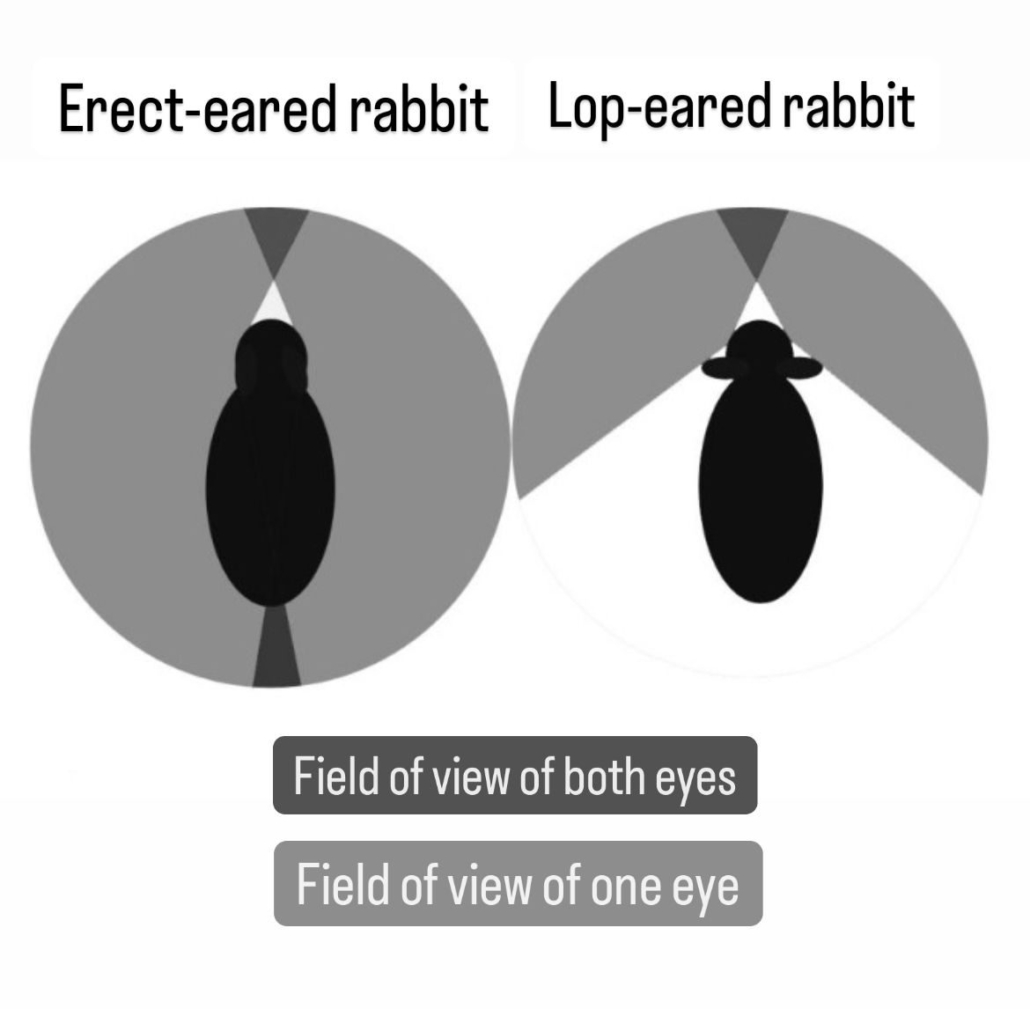
However, spatial vision is restricted in albino rabbits (they have mostly one-dimensional vision and weak eyesight). In addition, they are extremely light-sensitive and should be kept in the shade. Studies on albino rats have shown that even low light intensities of 60 lux can cause long-term eye damage (phototoxic retinopathy). These animals already avoid stronger light intensities from 25 lux onward. Non-albino rabbits, however, tolerate high light intensities without harm, e.g. 1200 lux over several weeks. Some albinos suffer from nystagmus or exhibit scanning movements to better perceive their surroundings. Lop rabbits (with floppy ears) have a restricted field of view compared to upright-eared rabbits due to their hanging ears (see illustration).

Day vision and color perception
Each animal species perceives its environment differently. To put ourselves in the place of our rabbits, it can be helpful to understand how they see the world.
Rabbits are farsighted (0.5–1 diopter), caused by a corneal curvature (astigmatism). They are especially good at detecting movement (at a distance), while nearby, motionless objects are seen poorly.

Normally, animals (including humans) can constrict or dilate their pupils depending on the amount of incoming light. Rabbits, however, can hardly constrict their pupils, which makes them very light-sensitive as crepuscular animals. Under strong sunlight, their vision is significantly impaired.
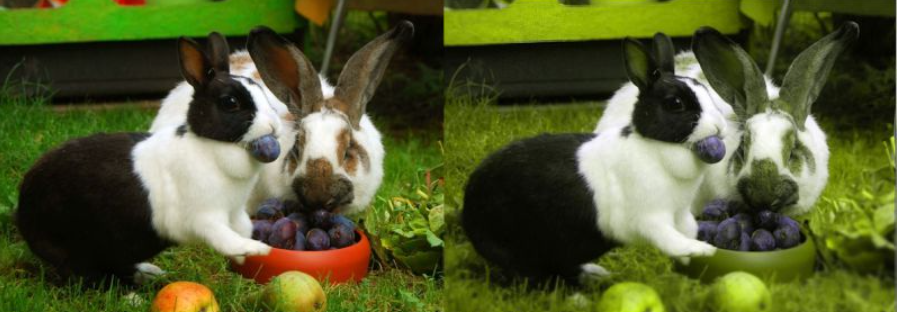
The eye contains different types of receptor cells responsible for vision. Rods enable the perception of various shades of gray, while cones are responsible for color vision. Rabbits have S-cones, which allow them to perceive violet-blue light, and M-cones, which allow them to perceive green light. Unlike humans, they lack cones that detect red light. Therefore, rabbits—similar to humans with red-green color blindness—see red and green as the same shade.
Rabbits cannot distinguish between red and green and are slightly farsighted. However, they are extremely good at detecting movement.
Night vision
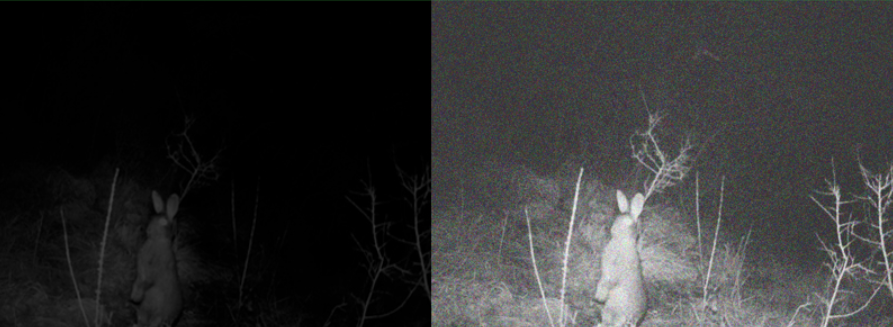
Rabbits are better able to orient themselves at dusk and in the dark than humans. Thanks to their large, dilated pupils and highly light-sensitive rods, they perceive their surroundings in low light as comparatively bright, which gives them good overall awareness. However, their ability to see details is limited.
Hearing (acoustic perception)
Rabbits have excellent hearing. They can perceive sounds in a frequency range between 60 and 49,000 hertz, whereas humans can only hear between 20 and 20,000 hertz. This means rabbits can detect very high-pitched sounds that humans cannot perceive (ultrasound).
The auricle (outer ear) contributes significantly to a rabbit’s sound perception. It is freely movable and can be rotated toward the direction of a sound. Rabbits can rotate their auricles almost 360 degrees (in all directions), independently of head movement. Each ear can also be oriented independently.
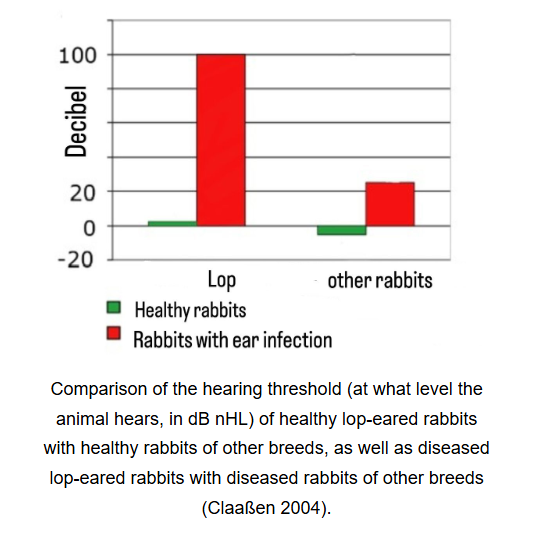
Depending on ear shape, rabbits may be limited in their acoustic perception according to breed. Rabbits with particularly small or heavily furred ears perceive acoustic stimuli less well than large-eared rabbits.

The most problematic case is found in lop rabbits (floppy ears). Studies show that lops are extremely hard of hearing and, due to chronic ear infections—which occur in up to 80% of lops as a breed-specific issue—often even become deaf. (See Lop rabbit problems.)
Smell (olfactory perception)
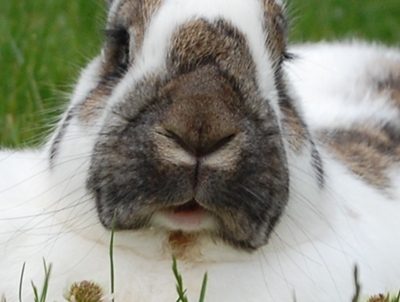
Rabbits rely heavily on their sense of smell. With over 100 million olfactory cells, it is highly developed. Depending on the breed, their sense of smell is comparable to that of dogs (100–200 million) and pigs, and about five times stronger than that of humans. For humans, it is hard to imagine how orientation through smell can be as precise as it is for many animals. Considering that truffle pigs can detect truffles through a thick layer of soil, one can better grasp the extent of a rabbit’s olfactory abilities.

Taste (gustatory perception)
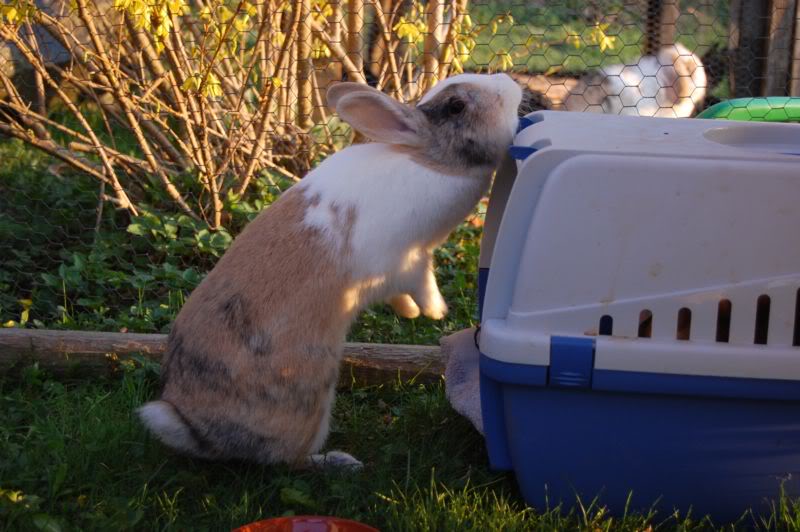
Rabbits, like humans, can perceive sweet, sour, bitter, and salty flavors. They have a particularly high tolerance for bitterness, which explains why they prefer especially bitter plants (e.g., dandelions). With around 17,000 taste buds (humans: 8,000–9,000; dogs: 1,700), rabbits have roughly twice as many as humans. This also explains why, as dietary specialists, they can detect subtle differences in food and selectively choose what they eat.
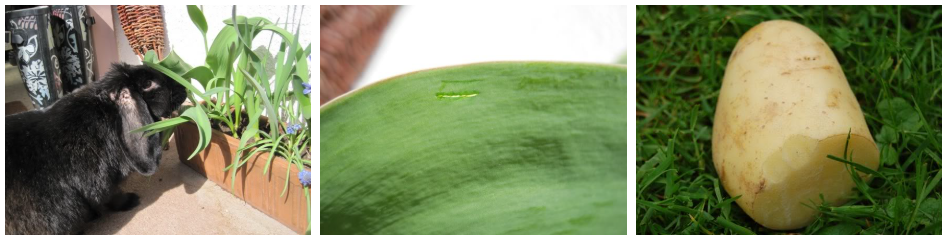
Rabbits first examine everything through their sensitive sense of smell before deciding to take a test bite. If the food is not suitable, they may spit it out again. This makes them very difficult to poison.
Touch (tactile perception)
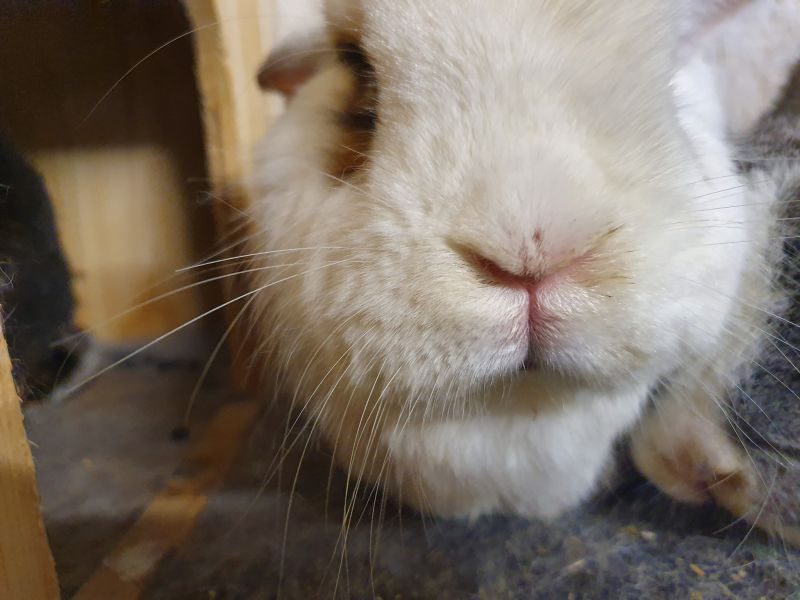
For close-range orientation, rabbits rely on their whiskers (vibrissae) located at the sides of the nose and above the eyes. They also possess tactile corpuscles, particularly at the ends of their limbs. Each side of the body has about 17–23 whiskers, each measuring 3–7 cm in length. Unlike fur, vibrissae are not shed during the molting cycle.
Whiskers help rabbits perceive things hidden from their eyes, and they rely heavily on them for orientation. With their vibrissae, rabbits can not only select food but also judge distances, feel the ground, and even sense vibrations in the air. This allows them to assess their immediate surroundings—for example, whether they can pass through an opening—and provides excellent orientation in burrows, shelters, and in darkness. The whiskers above the eyes help detect objects that might otherwise injure the eye.
When touched, the movement of a whisker is transmitted to the blood-filled capsule at its base, where a nerve conveys the stimulus to the brain.
Cutting off whiskers means amputating an entire sensory organ and significantly impairs the animal. Under no circumstances should whiskers be trimmed or shortened when clipping the fur.
In Rex rabbits, whiskers are often strongly curled, shortened, deformed, or even absent. The absence of whiskers is classified as a form of torture breeding (Qualzucht) in Germany, and such breeding practices are prohibited.


Sources include (among others):
Boback, Alfred W.; Das Wildkaninchen: (Oryctolagus cuniculus (Linné, 1758); 2., unveränd. Aufl.; Nachdr. der 1. Aufl., Wittenberg Lutherstadt, Ziemsen, 1970; Hohenwarsleben; Westarp-Wiss.-Verl.-Ges.; 2004; (Die neue Brehm-Bücherei; 415)
Engelhard, W. von et al (2014): Physiologie der Haustiere. Enke-Verlag, Stuttgart
Gormezano, I. N. Schneiderman, E. Deaux, and I. Fuentes (1962): Nictitating Membrane: Classical Conditioning and Extinction in the Albino Rabbit Science 138:33 – 34 [http://www.psychology.uiowa.edu/Faculty/Freeman/Gormezano_62.pdf, Stand 10.11.2019]
Heffner, H. (1980): Hearing in Glires: Domestic rabbit, cotton rat, feral house mouse, and kangaroo rat. J. Acoust. Soc. Am. 1980, 68(6), S. 1584-1599.
Hughes, A. (1971): A Schematic Eye For The Rabbit, Vision Res. Vol. 12, pp. 123-138. Pergamon Press
Kraft, R. (1976): Vergleichende Verhaltensstudien an Wild- und Hauskaninchen. Universität Erlangen, 1976. Diss
Leicht, W. H. (1979): Tiere der offenen Kulturlandschaft. Feldhase, Wildkaninchen. Heidelberg, Quelle und Meyer
Niethammer, F, Krapp, J.(2003): Handbuch der Säugetiere Europas. Hasenartige. Wiesbaden : Akademischer Verlags-Gesellschaft, Bd. 3/2
Juliusson, B. et al (1994): Complementary cone fields of the rabbit retina, in Investigative Ophthalmology 8c Visual Science, March 1994, Vol. 35, No. 3 [http://www.iovs.org/content/35/3/811.full.pdf Stand 10.11.2019]
Leicht, W. (1979): Tiere der offenen Kulturlandschaft, Heidelberg, Quelle und Meyer; Teil 1, Feldhase, Wildkaninchen; Ethologie einheimischer Säugetiere, 1
Loeffler, K., & Gäbel, G. (2015): Anatomie und Physiologie der Haustiere (Vol. 13). UTB.
Nachtsheim; In: Nachtsheim, H. u. H. Stengel (1977): Vom Wildtier zum Haustier. 3. Aufl. Verlag Paul Parey, Berlin und Hamburg
Schleif, O. (2001): Ein Beitrag zur tiergerechten Haltung der Ratte anhand der Literatur. Diss, Tierärztl. Hochsch. Hannover
Schlingmann F.; De Rijk SHLM.: Pereboom WJ.; Remie R.: „Avoidance“ as a behavioural parameter in the determination of distress amongst albino and pigmented rats at various light intensities. Animal Technol. 1993a; 44(2), 87-95.
Schlolaut, W. (Hrsg) in Zusammenarbeit mit Lange, K.; Das große Buch vom Kaninchen; 3., erw. Aufl.; Frankfurt am Main; DLG-Verl., 2003; 488 S.
Nover, A. (1955): Untersuchungen über die Funktion der Tränendrüse beim Kaninchen, in Graefe’s Archive for Clinical and Experimental Ophthalmology , Volume 156, Number 2
Walde, I. (2008): Augenheilkunde: Lehrbuch und Atlas Hund, Katze, Kaninchen und Meerschweinchen, 3. Auflage, Stuttgart
Wiesner, E. und Ribbeck, R. (2000): Lexikon der Veterinärmedizin. Stuttgart : Enke im Hippokrates Verlag GmbH.
















Leave a Reply
Want to join the discussion?Feel free to contribute!