
Feeding Rabbits with Dental Diseases
Does your rabbit have a dental issue? In many cases, an adjusted diet is necessary. Here are a variety of tips to help you find the right nutrition for your rabbit.
Mia Has No Molars but Thrives on Fresh Food
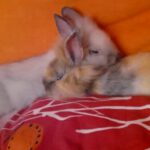
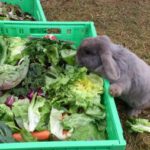
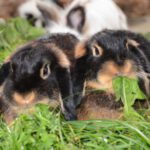
Mia doesn’t have a single molar left, but she still loves eating fresh food. You wouldn’t even notice her condition unless you knew—she bites off pieces with her incisors, chews the food on her gums, and swallows it. To keep her digestion stable, she gets a handful of Cuni Complete from the automatic feeder every day.
Correcting Dietary Mistakes and Promoting Tooth Wear
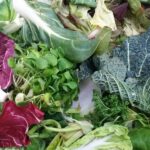
Dietary mistakes are often the root cause of dental diseases, which is why affected animals should be switched to a diet consisting solely of fresh green foods. However, if the incisors have been removed or the animal has severe molar misalignments, a specialized diet is required.
When a Rabbit Doesn’t Eat Independently After Surgery
If the rabbit isn’t eating on its own after surgery, the pain medication is usually underdosed. At least two painkillers should be combined for effective pain management. Rabbits require significantly higher doses of pain medication compared to dogs and cats! Unfortunately, these are often prescribed at much too low a dosage.

Every Rabbit with Dental Issues Needs a Tailored Diet!
After Dental Procedures
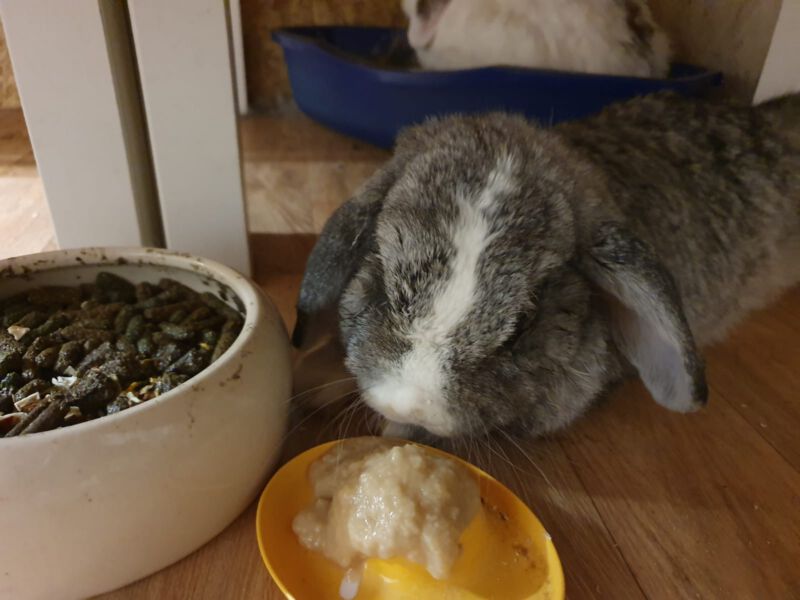
Following dental surgery, rabbits can often only eat soft foods temporarily, such as porridge (made from commercial recovery feed, mixed to a thick consistency), oatmeal, soaked Cuni Complete, and similar options. This is usually necessary for about two days, as their teeth or gums may be sore. In many cases, force-feeding is not required, as most rabbits will willingly eat soaked Cuni Complete on their own. It’s a good idea to introduce soaked Cuni Complete before the surgery to familiarize the rabbit with it.
Rabbits with Chewing Difficulties, e.g., Due to Molar Problems
While some rabbits with molar issues can still be fed a normal diet, severe molar diseases often prevent proper chewing, leading to food being swallowed unchewed. For rabbits that struggle with a regular diet, soaked hay pellets (e.g., JR Farm Grainless Complete) or soaked Cuni Complete (without mashing) have proven effective.
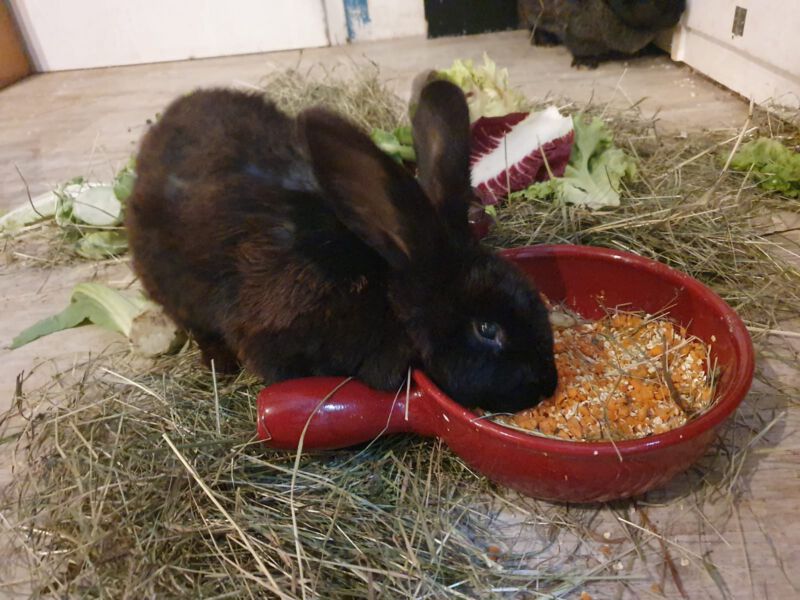
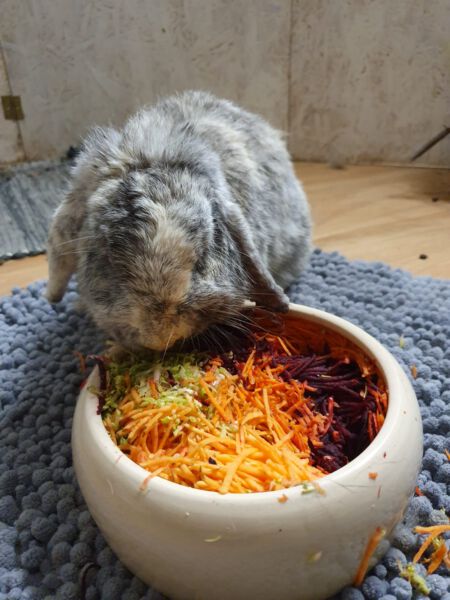
A diet consisting solely of fresh greens, especially in large quantities, can often cause digestive issues if the food is poorly chewed. In such cases, feeding soaked Cuni Complete twice daily can help stabilize digestion, making fresh greens more digestible again. If no functional chewing surfaces remain, soaked Cuni Complete should also be provided. Additionally, these rabbits often do well with finely grated vegetables, prepared with a grater or food processor.
In extreme cases, small amounts of oatmeal can be given, particularly after dental surgeries—but care must be taken to ensure it doesn’t cause digestive upsets or diarrhea.
Once the rabbit’s chewing improves, soaked dry food, oatmeal, and similar items should be reduced or eliminated, as they may hinder the wear of any remaining, growing molars.
Some rabbits may respond to soaked dry food with increased cecotrope production (sometimes liquid). In such cases, reducing the amount of soaked dry food and adding oregano-infused drinking water to the soaking water can help.
Rabbits Without Incisors
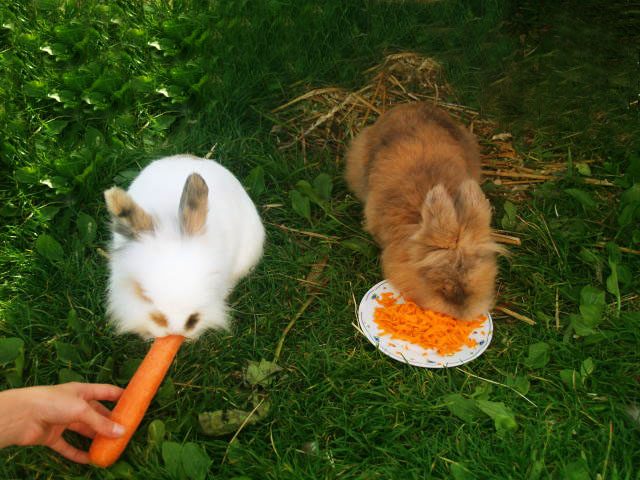
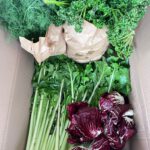
Rabbits that no longer have incisors can be well-fed with long vegetable strips, hand-picked meadow herbs, leafy greens, hay, and grated vegetables, as they can usually no longer manage whole, firm vegetables. The best practice is to serve them a plate of assorted grated vegetables twice a day, along with enough leafy greens like dandelion, grass, bitter lettuces, and carrot tops to last them until the next feeding. Leafy greens should ideally be cut into thin strips to make them easier to eat.
For rabbits struggling with food intake, soaked hay pellets in plenty of water or herbal tea, mixed with grated vegetables, can be a helpful alternative.
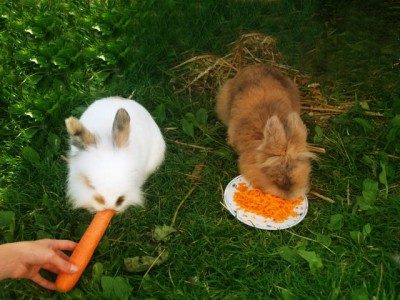
If companion rabbits eat the grated vegetables intended for the toothless rabbit, you may need to grate larger amounts. A food processor can make chopping easier and more efficient. Whole cabbage heads, for instance, can be easily sliced with a large knife into thin strips that rabbits find manageable.
After the removal of the incisors, it often takes time for the wounds to heal and for the rabbit to adapt to eating without them. During this transition, grated vegetables and, if needed, small portions of oatmeal or seeds can help maintain weight. Leafy greens, dandelions, and hay are usually accepted more readily as the rabbit becomes accustomed to its new feeding method.
A long-term diet of porridge is not recommended. While porridge can be offered temporarily after incisor removal until the rabbit consumes sufficient amounts of other food, it does not provide adequate wear for the molars, unnecessarily strains the digestive system, and is generally less appealing to rabbits compared to grated vegetables.
Fresh meadow forage should remain an essential part of the diet for all rabbits, including those without incisors, especially in the summer months. It provides the necessary tooth wear to maintain the remaining teeth and serves as an excellent dietary base. However, since rabbits without incisors cannot graze directly, the meadow forage must be hand-picked and offered to them.
Feeding in a Group: The Other Rabbits Eat the Special Food
It is often a challenge to provide rabbits with special diets when they are kept in a group. Often, the food given to one rabbit is not particularly healthy for the rest of the group, who are supposed to primarily eat fresh greens.
There are several ways to feed the rabbit separately:
- The rabbit is briefly separated or removed from the enclosure 1-2 times a day and given its special food. Otherwise, it eats with the group as usual.
- A chip-controlled cat flap is used to provide the sick rabbit access to a separate area (e.g., a box, rabbit hutch, or transport box), while keeping the other rabbits out. The sick rabbit is chipped for this purpose.
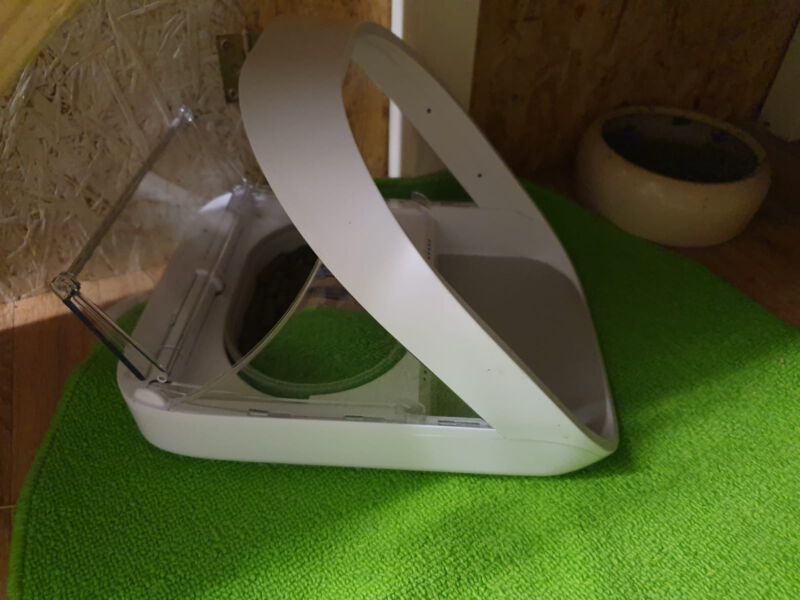
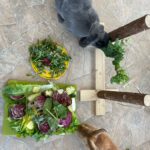
- A Sure-Feed automatic feeder is used, which only opens for the chipped rabbit that has been registered in the system. The plastic mat should be removed (since rabbits tend to chew on it), and if the rabbit pulls the bowl out of the feeder, heavy ceramic bowls are ideal. If another rabbit tries to eat from the feeder, the anti-intruder mode should be activated. Additionally, you can prevent other rabbits from eating by attaching a cover to the feeder or narrowing the eating space by attaching a piece of wood to the side or placing the feeder on top of a small house, ensuring that no other rabbit can get in while the sick rabbit is eating.
SureFeed Chip Feeder
Advantages:
- Opens quickly and stays open once the correct rabbit is recognized.
- Reliably detects the rabbit through the chip.
Disadvantages:
- A second rabbit can fit next to the feeding rabbit and eat from the feeder. The anti-intruder mode helps, and you can also prevent eating from behind by adding a snap-on cover. Additionally, you can narrow the feeding space by attaching a piece of wood to the side or placing the feeder on top of a small house, ensuring no other rabbit can squeeze in while the first one eats.
- The bowl can be thrown out, but there are ceramic bowls that prevent this issue.
- It’s a bit more expensive than the Closer Pets MiBowl.
- It’s available with Wi-Fi and an app, allowing you to monitor the rabbit’s eating behavior, even from work, which is helpful for rabbits that sometimes don’t eat well.
Conclusion:
With a few adjustments, the SureFeed is a great solution!
Closer Pets MiBowl Microchip Feeder
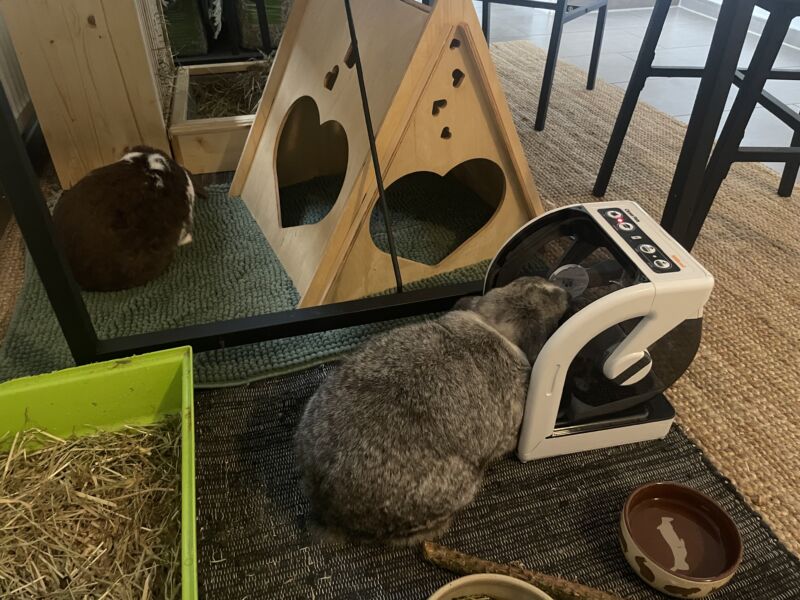
Advantages:
- Cheaper than the SureFeed.
- The bowl is securely attached and cannot be thrown out.
- Only one rabbit can access the feeder at a time.
- Side-mounted plastic plugs can narrow the feeder to fit the size of the rabbit, preventing other rabbits from eating.
Disadvantages:
- It seems to have trouble recognizing many chips, which may require a return or exchange.
- The feeder opens very slowly and sometimes closes even when the rabbit is still in front of it, which can make acceptance more difficult for the rabbit.
Conclusion:
If the rabbits can get used to the slow opening and closing while eating, and if the chip is recognized properly, the Closer Pets MiBowl is a great option. It is easy to return through Amazon if the rabbit is not recognized or has trouble with the feeder. Due to its lower price, I would recommend trying it first, and if it doesn’t work, I would suggest upgrading to the SureFeed.
Chip Cat Flaps
The flap needs to be installed in an enclosed space where you can feed the sick rabbit in peace. Compared to a feeder, it provides more room and allows you to offer things like grated vegetables, medication in food, etc. For the enclosure, you can use a laundry basket, transport box, or wooden box. A disadvantage is that it takes up quite a bit of space in the enclosure, so it may not be ideal in smaller enclosures or free-roaming living setups.
Here are the models I have tested:
1. PetSafe Microchip Cat Flap (approx. €65):
- Advantages:
- Reliable chip recognition and straightforward design.
- Works well for feeding a sick rabbit in a designated area.
- Disadvantages:
- The flap is relatively small and may not be suitable for larger rabbits or multiple animals.
- Requires installation in a door or wall, which may not be ideal depending on your setup.
2. Sure Flap Microchip Cat Flap (approx. €95):
- There is a version for larger pets, suitable for bigger rabbits, and it can be connected to Wi-Fi via an app for remote monitoring.
- Advantages:
- Reliable chip recognition, even for larger rabbits.
- With the app and Wi-Fi connection, you can monitor feeding behavior, which is a great feature for rabbits with specific dietary needs.
- Disadvantages:
- Requires a hub for the Wi-Fi connection, making it more expensive.
- Installation may be more complex, and the higher price should be considered.
Conclusion:
While chip-controlled cat flaps are effective for creating a separate feeding area for sick rabbits, they do take up more space and may not be suitable for all setups. The PetSafe option is more affordable, but the Sure Flap model offers additional features like Wi-Fi connectivity and a larger flap, which can be a great choice for bigger rabbits or those with more complex needs. However, consider the installation and price before deciding.
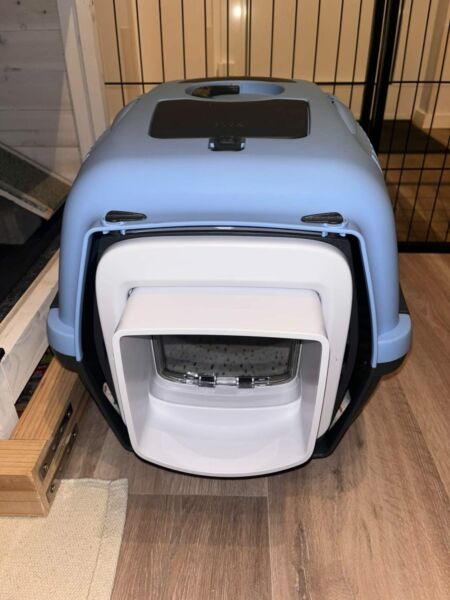
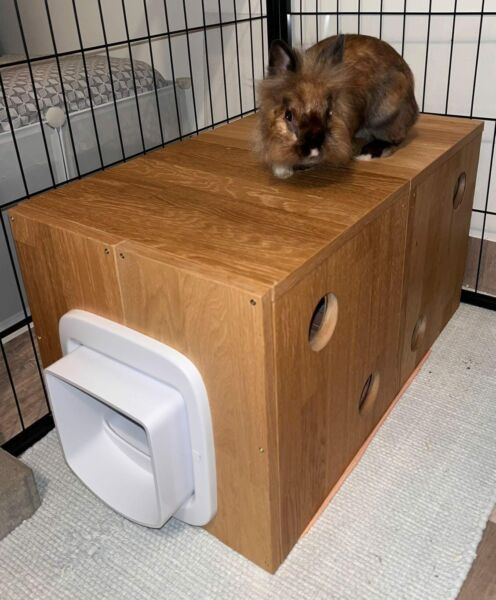
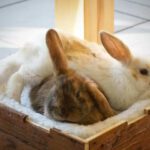
A chip cat flap is used to allow only the dental sick rabbit access to its private feeding area.