
Contents
- Aggression Toward People
- The most common causes of aggression in rabbits are:
- Other Causes of Aggression:
- Normal Rabbit Body Language (Nipping, Nudging, and Gentle Bites)
- Fear-Based Aggression (Biting when there is no opportunity to hide)
- Territorial and Food-Related Aggression
- Frustration Aggression
- Hormone-Driven Aggression/Sexual Frustration
- Learned Aggression
- Pain
- Estrus and Pseudopregnancy
- Accidentally Mistaking a Finger for Food
- Accidental Bites When Breaking Up Fights Between Rabbits
- Aggressive behavior towards other rabbits
- “My rabbit bit/injured another rabbit”
Aggression Toward People
“My rabbit growls, lunges at me, or bites me!”
Aggression toward people can have many different causes. It is important to observe your rabbit’s behavior carefully to identify the trigger.
The most common causes of aggression in rabbits are:
- A housing setup or enclosure that doesn’t allow your rabbit to express its natural behavior, leading to frustration and pent-up energy (for example, being confined to a cage or hutch instead of having 24/7 access to a spacious enclosure).
- Not having a rabbit companion/partner.
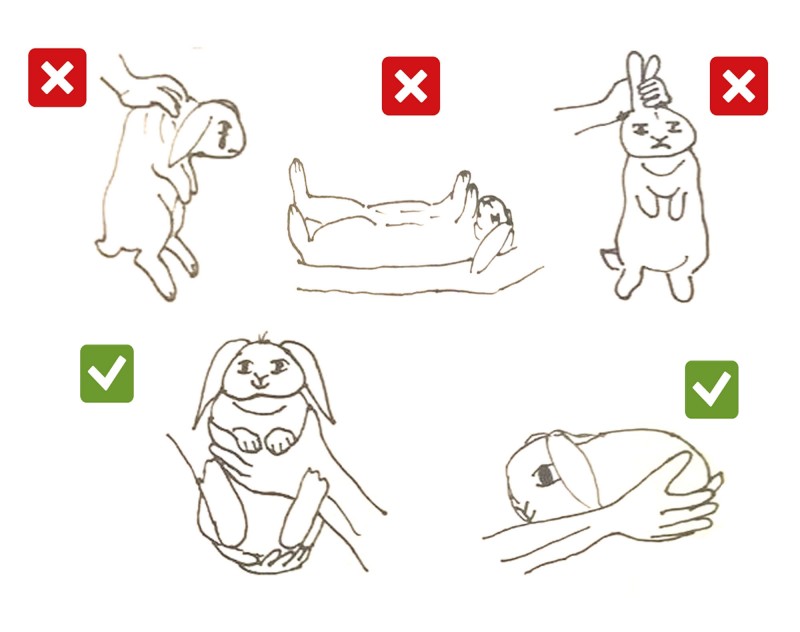
- Handling that makes the rabbit feel threatened, such as picking it up, carrying it, cuddling it against its will, or cornering it.
With a compatible rabbit companion, a spacious enclosure, and plenty of opportunities for natural enrichment and activity, aggressive behavior will often decrease or disappear within just a few days—as long as the rabbit is given the space it needs and is left in peace.
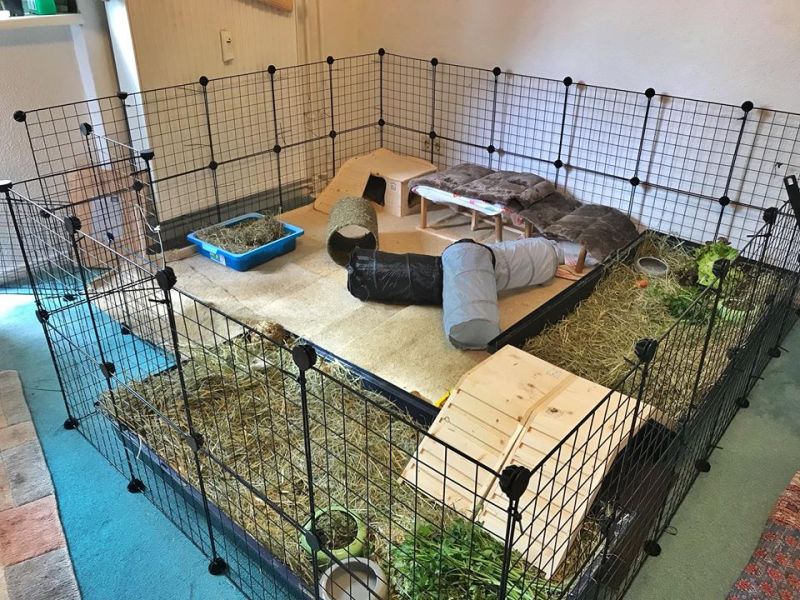

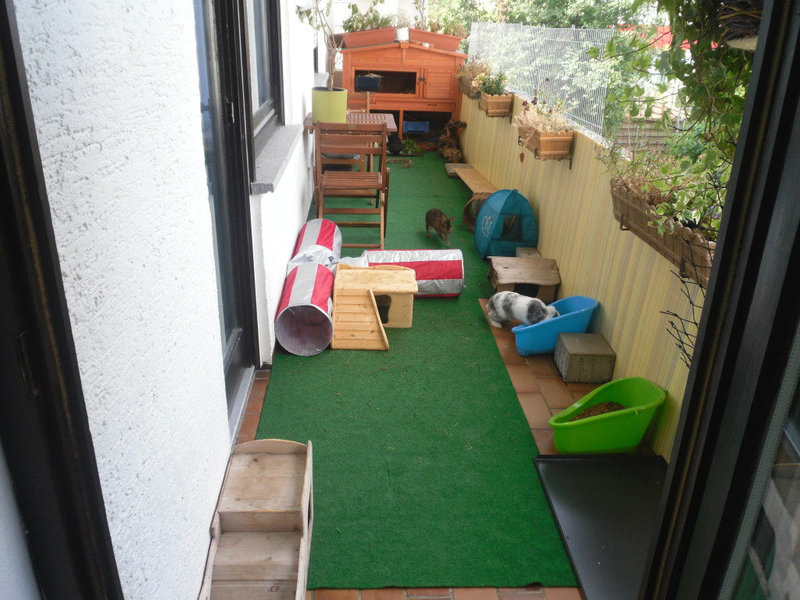
Read the linked articles to learn more about improving your rabbit’s housing, finding a suitable companion/partner, and learning how to build trust without frightening your rabbit. Rabbits that feel threatened often resort to fear-based aggression to make people leave them alone.

To help your rabbit form positive associations with people, always approach at its level (not from above) and offer a favorite treat whenever you approach it. Never corner, pester, or force your rabbit to interact. Instead, give it plenty of space and escape routes so it can choose to approach you on its own.
If your rabbit continues to attack despite having optimal housing, a compatible companion, and being approached calmly, bending down and moving slowly—without being cornered, restrained, or pressured—this behavior is often the result of years of inappropriate housing or handling. In these cases, the aggressive response has become deeply learned and will need to be changed gradually through careful behavioral training. Owners in this situation should seek guidance from someone experienced in rabbit behavior and rehabilitation.
Other Causes of Aggression:
Normal Rabbit Body Language (Nipping, Nudging, and Gentle Bites)
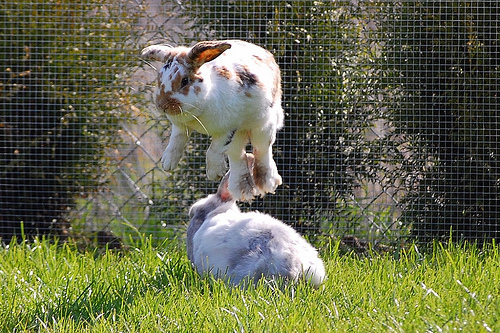
Nudging and gentle nipping are a normal part of rabbit body language and are used when interacting with other rabbits. These behaviors do not cause injuries or break the skin.
Rabbits may also communicate with people in the same way. For example, they might tug on your shoe or trouser leg to get your attention or ask for food. This is simply one way your rabbit communicates with you.
Fear-Based Aggression (Biting when there is no opportunity to hide)

When rabbits feel trapped or unable to escape, they either freeze or defend themselves. If a rabbit feels threatened, it may bite.
A rabbit can feel threatened if it is approached incorrectly—for example, from above or in another way that it finds frightening. Fear-based aggression can also develop after negative experiences. Rabbits that are afraid of being picked up, carried around, or cuddled may bite in self-defense.
Rabbits feel safest with all four feet on the ground and generally prefer to be interacted with there. Being picked up or restrained is frightening for most rabbits, and they may bite out of fear.
Rather than cornering or restraining your rabbit, approach it calmly and respectfully, and always make sure it has the option to escape if it doesn’t want to be touched.
Territorial and Food-Related Aggression
Some rabbits become protective of their food, food bowl, or hutch/cage and may deliver a serious bite when someone reaches in to refill their food.
This behavior is especially common in rabbits that are kept alone or in cramped living conditions. Unneutered males are also more likely to show this type of aggression.
The behavior can usually be improved by:
- neutering unneutered males,
- bonding solitary rabbits with a compatible companion,
- providing a spacious enclosure with several square meters of permanent living space, plus additional exercise space.
It also helps to remove food bowls (do not remove the water bowl) and scatter or hide food throughout the enclosure instead. This eliminates a single feeding area that the rabbit feels the need to defend.
Providing a large digging box is also recommended, as it gives rabbits an appropriate outlet for natural behaviors and helps reduce frustration.
If your rabbit is guarding its hutch, leave the hutch open or remove it altogether, and provide other, more open, shelters instead. If your rabbit lives in a cage, remove the top section and use only the bottom tray as a litter box in a different location within the enclosure.
To help food-aggressive rabbits learn that your hand is not a threat, you can offer them long pieces of food—such as celery stalks or leafy greens with long stems—from your hand. This allows the rabbit to take the food while maintaining a comfortable distance.
Frustration Aggression
This type of aggression is caused by redirected frustration. When a rabbit is unable to meet its basic behavioral needs or doesn’t have enough mental and physical stimulation, it may channel that frustration into aggressive behavior.
The most common cause for this is an unstimulating environment. Rabbits need plenty of variety, environmental enrichment, social interaction with other rabbits, enough space to run and exercise, a digging box, opportunities to explore and forage, and regular exercise outside their enclosure. Many housing setups fail to meet these needs.
To reduce frustration-induced aggression, provide a large enclosure with at least 6 m² (approx. 65.6 sq ft) of permanent floor space. Offer new enrichment every day, provide a large sand-filled digging box, allow daily exercise outside the enclosure, and regularly introduce new experiences and activities.
Frustration can also be caused by a lack of suitable hides and areas to retreat where the rabbit can truly be left alone, or by being repeatedly bothered—for example by children.
Young, active rabbits may also become frustrated if their companion grows old or becomes less mobile and can no longer keep up with them. In some cases, the younger rabbit may even direct this frustration toward its older companion. This is why it is important to pair rabbits of a similar age and activity level.
Hormone-Driven Aggression/Sexual Frustration
Rabbits experiencing sexual frustration—such as unneutered males, unspayed females during estrus (heat) or a pseudopregnancy, intersex rabbits, or rabbits with hormonal disorders—often display excessive sexual behavior that can develop into frustration-induced aggression.
These rabbits are overwhelmed by hormone levels they have no natural way of satisfying, which can lead to aggressive behavior.
These rabbits should be neutered or spayed as soon as possible whenever appropriate.
Learned Aggression
Your rabbit may have bitten out of frustration one day and discovered that people naturally pull their hand away. Some rabbits quickly learn that biting makes unwanted hands or objects disappear, and they begin to bite whenever something gets in their way or bothers them.
The only way to change this behavior is to respond differently so your rabbit learns that biting no longer achieves the desired result.
Until this behavior has been successfully unlearned, avoid putting your hand close to your rabbit. Instead, use a soft brush (you can attach a longer handle to it if necessary) to gently stroke your rabbit. If it bites the brush, don’t pull the brush away. Simply hold it still. Always make sure your rabbit has enough space to move away if it becomes frightened.
Practice this exercise twice a day until the aggressive behavior improves and your rabbit is comfortable being stroked by your hand again.
As an alternative to a brush, you can wear thick gloves while gently petting your rabbit.
Pain
Many animals react irritably toward their surroundings or being touched/approached when feeling unwell or in pain. In some cases, this can lead to biting.
In female rabbits, the underlying cause is often uterine disease. These conditions can cause severe pain while remaining externally symptom-free or otherwise going unnoticed. In lop-eared rabbits, hidden middle ear infections are a frequent cause. Dental root disease is another very common reason for pain-related aggression.
Once the rabbit receives veterinary treatment and is free of pain, the aggressive behavior usually disappears on its own.
If the initial cause of pain cannot be determined, consulting your vet and administering a high dose of pain medication may be worth a try. Make sure to monitor the rabbit’s behavior during this time. If the behavior is pain-related, an improvement should be noticeable. If it is a behavioral problem rather than a response to pain, the rabbit will show no change in behavior.
Estrus and Pseudopregnancy
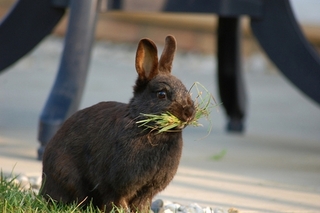
Female rabbits go through hormonal phases several times a year, including periods of estrus (being in heat) and pseudopregnancy. During these times, they may show behaviors such as nest building, pulling out fur, carrying hay or grass in their mouths, digging, burrowing, becoming more territorial, or reacting irritably.
These phases usually only last a few days, so any aggression is generally temporary. Once the phase has passed, the rabbit typically returns to her normal, balanced temperament.
Providing a large digging box filled with sand during this time can help satisfy her natural instincts and provide an outlet for these behaviors. Other than this, it is best to give her space and avoid unnecessary handling until the phase has passed.
Accidentally Mistaking a Finger for Food
Occasionally, a rabbit may mistake a finger for a treat, especially when it is excitedly reaching for food from a person’s hand. The bite is usually accidental and happens in the rush to get the food.
Accidental Bites When Breaking Up Fights Between Rabbits
Trying to separate two fighting rabbits with bare hands is risky. A rabbit may accidentally bite a person while aiming for the other rabbit during the struggle.
Aggressive behavior towards other rabbits
“My rabbit does not get along with other rabbits”
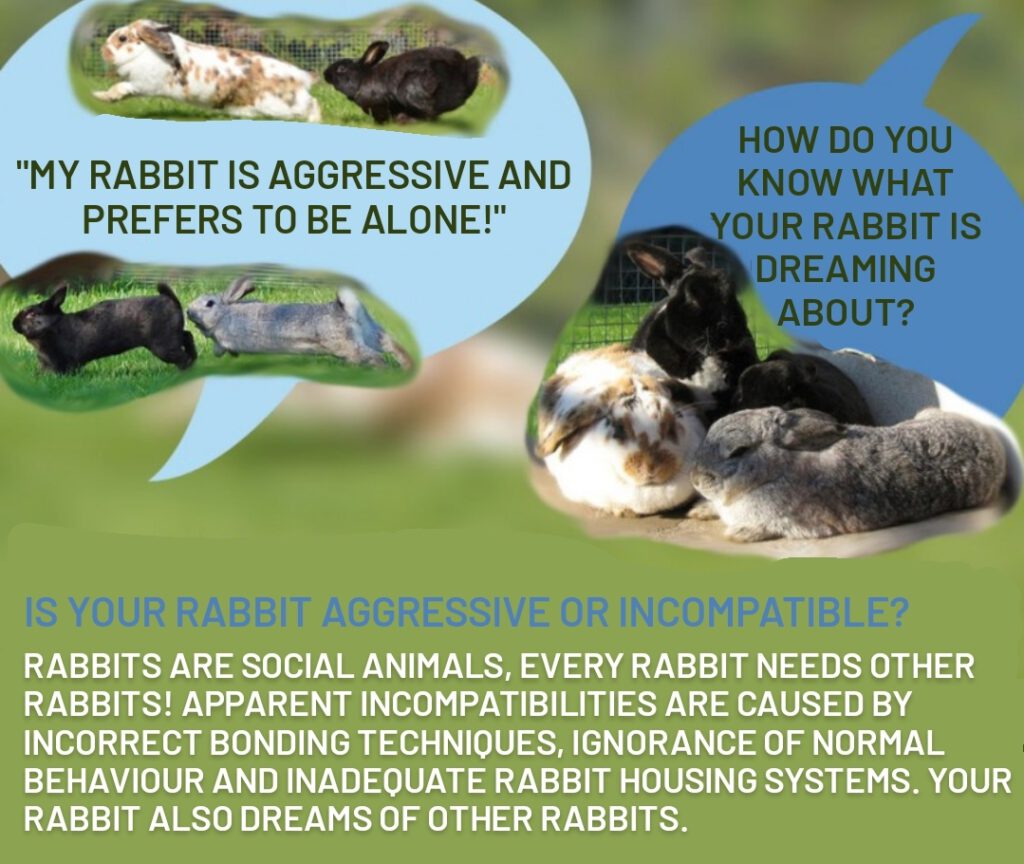
Successfully bonding rabbits requires a good understanding of their complex social behavior, which can be difficult for owners to interpret. As a result, many owners struggle with rabbits that appear incompatible, fail to bond, show aggression, and/or seem to “prefer living alone.”
Rabbits are highly social animals, and there are no rabbits that are inherently “unable to get along” with others. We regularly take in rabbits described as incompatible for bonding or rehoming, and so far, none of them have been genuinely impossible to bond. Every one of them has eventually found a suitable companion.
But why do some rabbits appear to not get along with each other?
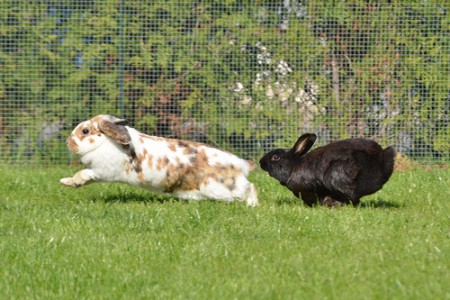
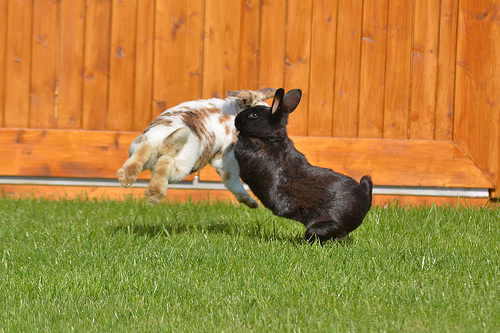
- A lack of understanding of normal rabbit behavior during bonding. Chasing, mounting (humping), and scuffles are attempts to establish dominance and normal parts of the bonding process. Even aggression through a cage barrier can be a normal reaction, especially when rabbits are defending their territory, as rabbits can be extremely territorial.
- An incorrect approach to bonding. Many problems arise when bonding rules are not followed or when the process is interrupted or stopped early. A proper introduction requires patience and an understanding of the different stages of bonding (see Common Bonding Mistakes, How to Bond Rabbits).
- Incompatibility between partners. Not every pairing is ideal. Factors such as age, personality, and sex can influence compatibility (for example, pairing a young rabbit with a much older rabbit or an unsuitable same-sex pairing; see Partner Selection).
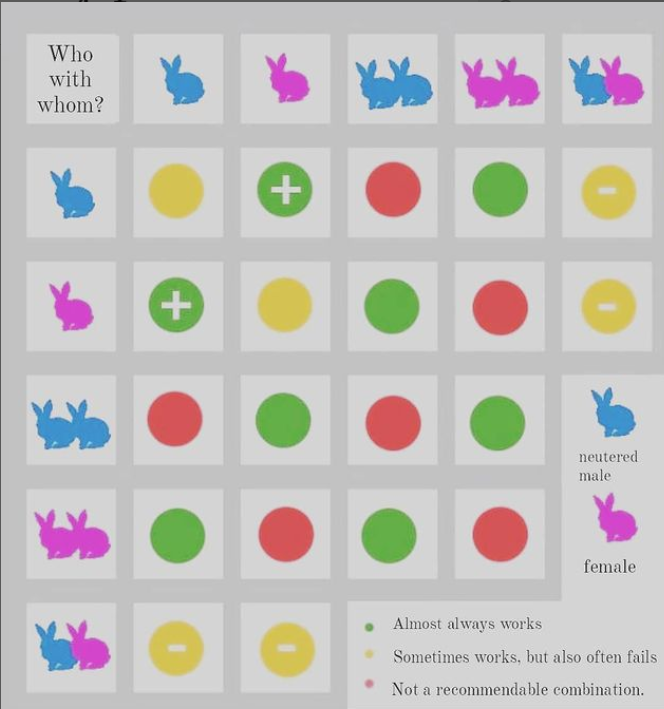
When rabbits are introduced carefully according to proper bonding guidelines and a suitable partner is chosen, true incompatibility is very rare.
If a bonding attempt does not work out, this does not mean that the rabbit is generally unable to live with other rabbits. It may simply mean that a different rabbit will be a better match.
“My rabbit bit/injured another rabbit”
There are many reasons why rabbits may bite or injure each other. The most common causes include:
- Insufficient living space. Keeping rabbits confined to a small hutch or cage can lead to frustration and conflict. Learn more about appropriate rabbit housing — rabbits need plenty of space around the clock, including at night.
- An unsuitable group combination. (See Partner Selection)
- A rabbit that has been severely bullied. Even a very submissive rabbit may eventually defend itself if it is constantly harassed.
- Fights over hierarchy. Establishing rank within a group can involve chasing, mounting, and scuffles.
- Puberty and hormonal changes. This is especially common around 6–14 months of age and may be linked to hormonal imbalances, being in heat, or pseudopregnancy.
- Illness or pain. A rabbit that is unwell or in pain may become aggressive toward other rabbits. Uterine disease is a common cause of pain in females.
- Springtime.
- A change in the group dynamic. A new hierarchy may need to be established after the death of a rabbit, if one rabbit becomes weaker due to age or illness, or when a young rabbit reaches adulthood.
- (Incorrectly) reeintroducing rabbits after separation. Rabbits that have been separated may need to re-establish their relationship. Not following proper re-bonding guidelines can lead to further conflict.
- Unneutered male rabbits. Male rabbits must be neutered in order to safely be part of a social group.
Most of the time, these factors initially lead to chasing and conflict rather than serious injuries. Several factors usually have to come together before rabbits cause severe injury. For example, injuries are more likely to happen when rabbits that do not know each other meet in one rabbit’s territory, or when a poorly matched and unstable group experiences renewed hierarchy conflicts in spring and a rabbit that has been repeatedly bullied finally fights back.
That being said, keeping a rabbit alone is never the solution. Instead, the underlying cause should be addressed, the rabbits should be bonded following proper guidelines, and their environment should be optimized so they can live happily with a suitable companion.
At our rescue centre, we regularly take in extremely challenging cases with rabbits that are considered extremely difficult to bond — including rabbits that have seriously injured or even killed other rabbits, or those where multiple bonding attempts have failed. These can include highly territorial rabbits that immediately establish a territory even in neutral areas, rabbits that have developed problematic social behaviors, or rabbits suffering from hidden health issues. Conditions such as thymomas, lymphomas, and heart disease are often difficult to detect, even with blood tests, because they may not show up in standard results.
With the right medical treatment and carefully developed bonding approaches, we have successfully bonded every rabbit we have taken in.