
Summary: Diet change in young rabbits
- Completely withdraw pellets within a few days.
- Before that, perform a fecal analysis to rule out coccidia (pooled sample from 3 days).
- Start feeding vegetables, herbs, and grasses, increasing the amount gradually each day.
- Introduce cabbage and clover no earlier than two weeks after the diet change is fully completed.
An early and consistent transition in diet is essential to ensure the long-term health of young rabbits. Especially during the first months of life, both the teeth and the jawbone are still developing, and at this stage the type of diet has a decisive influence. An inappropriate diet, particularly the feeding of dry pellets, can cause permanent damage that will affect the rabbit for its entire life and is often associated with pain and high veterinary costs.
Why dry pellets are so harmful for young rabbits
Many young rabbits become accustomed to dry pellets at the breeder’s or in pet shops. What seems convenient is, in reality, a serious health risk:
- Young rabbits are not yet able to properly digest starch, so pellets disrupt and damage the intestinal flora.
- Pellets require very little chewing and therefore do not wear down the continuously growing teeth.
- The chewing motion for pellets differs fundamentally from that for fresh greens and places excessive pressure on the sensitive growth zones of the teeth. This leads to incorrect loading of the jaw and forces the skull to develop as if a strong downward chewing movement were necessary.
This faulty development can cause permanent deformities, increasing pressure on the teeth and resulting in dental diseases such as:
- Malocclusion
- Dental abscesses
- Recurrent enamel spurs
- Chronic dental disease
- Pain-related loss of appetite
The risk is especially high in young animals because the bones of the skull are still soft and shapeable. The rule is simple: the earlier rabbits are fed a species-appropriate diet, the better their teeth and skull will develop.
What is meant by dry feed?
This includes all muesli-style mixes, pellets, compound feeds, extruded feeds, dried vegetables, etc.More information on why it is harmful: Dry feed?
Rapid removal of dry feed in young and baby rabbits
In young rabbits, dry feed should be eliminated quickly and consistently. A slow, step-by-step reduction is unnecessary and can even be counterproductive, because it prolongs an unnatural chewing pattern that places incorrect stress on the teeth and their growth zones. This prolonged misloading promotes abnormal development of the jaw and the dentition.
Recommendation:
→ Completely eliminate dry feed within a few days.
A transition to fresh food is easily possible even in young animals that have previously been fed only dry feed, provided it is done correctly.
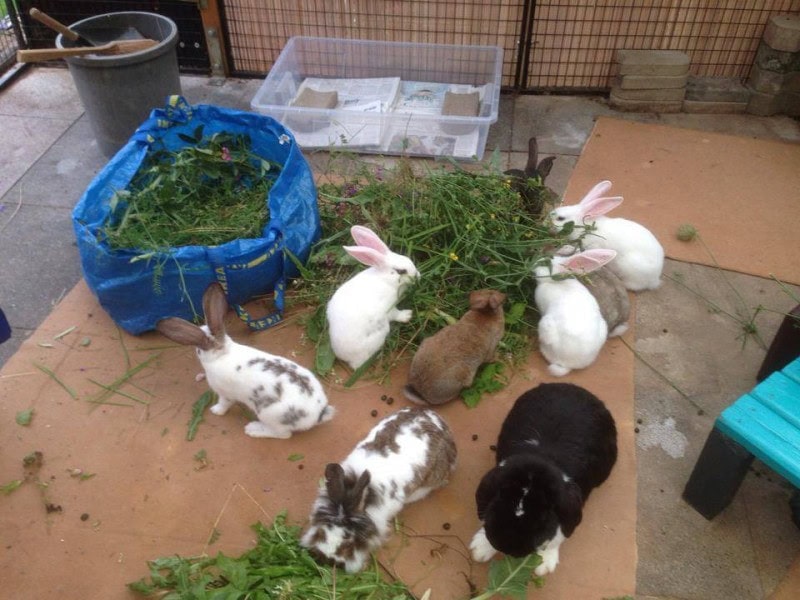
Responsible origin: acquiring young rabbits raised correctly from the start
Ideally, rabbits should come from a breeder or rescue that completely avoids dry feed from the beginning and raises the animals exclusively on fresh food and grass. It is equally important that regular fecal examinations are carried out and that the group is confirmed to be free of coccidia.
Rabbits raised under these conditions are usually much more resilient, develop a healthy gut flora, and show proper development of the skull, jaws, and teeth. They also adapt easily to a natural diet based on vegetables, herbs, and grasses.
When a rabbit is fed in a responsible, species-appropriate way from the first weeks of life, feeding later on becomes much easier, and the lifetime risk of chronic dental disease or digestive problems is significantly reduced.
The presence of coccidia during growth, as well as feeding dry feed to young and baby rabbits, can cause severe developmental disorders and damage the intestinal flora and skull shape in such a way that the animals remain more prone for life to dental disease and digestive problems
Fecal examination and coccidia screening before changing the diet
If rabbits were raised on dry feed, it can be assumed that they come from an irresponsible source, and such animals almost always also carry intestinal parasites.
Before switching young rabbits to a fresh-food diet, a fecal sample should always be examined by a rabbit-experienced veterinarian, ideally a pooled sample collected over three days. It is especially important to rule out coccidia, as these intestinal parasites are very common in young animals and can multiply rapidly under stress, during dietary changes, or after transport. If a coccidia infection is already present, the transition to fresh greens can place additional strain on the gut. Therefore, the following rule applies:
→ Treat first, then change the diet.
This prevents the animals from developing gastrointestinal problems or even severe illness caused by the combination of a parasitic infection and a dietary change. Coccidia are the leading cause of death in young rabbits.
Rapid and proper introduction of fresh greens in young rabbits
Young rabbits have a highly adaptable digestive system that can quickly adjust to a natural, high-fibre diet. For this reason, they should be offered plenty of fresh food from an early age.
How to introduce fresh greens correctly:
Start with well-tolerated plants
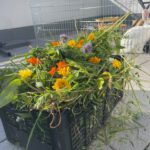
- Wild plants (dandelion, ribwort plantain, broadleaf plantain)
- Fresh grass
- Aromatic herbs such as dill, parsley, and basil
- Leafy vegetables such as carrot tops, celery leaves, and escarole
Increase the amount gradually but consistently
Add a little more each day, always making sure that the droppings remain normal. As a guideline: double the amount from the previous day.
Always offer fresh food in abundance
Rabbits must not go hungry; during growth they need constant access to food. After a few days of adaptation, offer so much that some is still left at the next feeding — which can be a large quantity. Whole heads of lettuce or cabbage can even be placed in the enclosure.
Provide hay
As an additional source of fibre and to ensure proper tooth wear.
Tip: Use our food lists:
- Wild herb list
- Grass list
- Vegetable list
- Aromatic herb list
- Branch list
- Fruit list
- Seed list
- Garden plant list
- Houseplant list
More information on coccidia
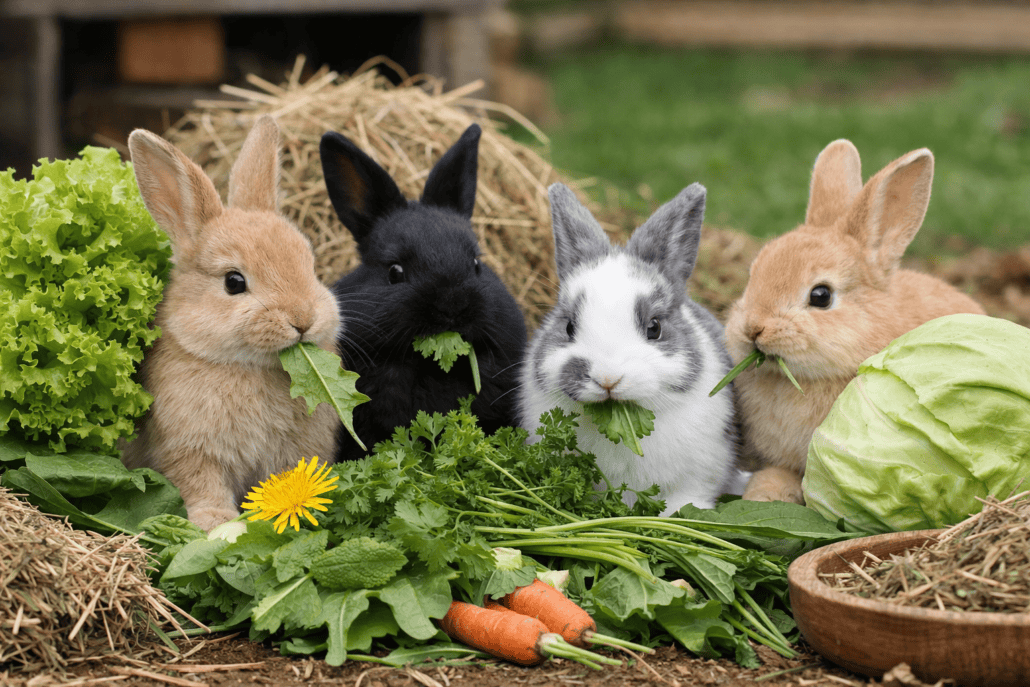
Cabbage and clover: introduce later
Cabbage and clover are very healthy, but they are not well tolerated by an intestinal flora that has been damaged by dry feed.
For this reason, they should only be introduced after dry feed has been completely eliminated for at least two weeks.
→ First, completely eliminate all dry feed
→ Two weeks of stabilization on well-tolerated fresh greens
→ Then gradually introduce cabbage and clover varieties (e.g. kale, red clover, white clover)
What to do if baby rabbits develop diarrhea or soft droppings
Slightly soft droppings during the transition phase are not unusual. It only becomes a problem if:
- the droppings become watery,
- the rabbit becomes lethargic,
- or stops eating.
In these cases, a rabbit-experienced veterinarian must be consulted immediately.
In all other cases, the amount of the new food can be reduced slightly and then increased more slowly.
An early transition to a natural diet provides lifelong protection
Young rabbits benefit greatly when they are introduced early to a natural diet based on meadow herbs, aromatic plants, and leafy vegetables. Proper nutrition during the growth phase helps prevent dental problems, strengthens the intestinal flora, and lays the foundation for a long and healthy life.
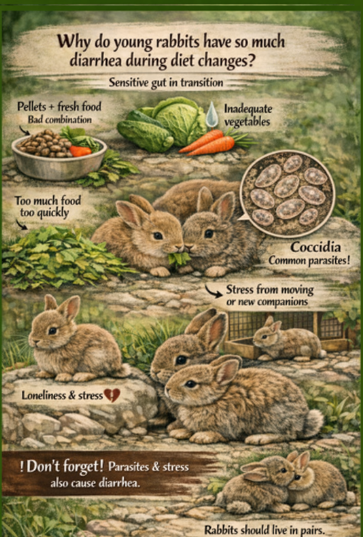
Why do young rabbits so often develop diarrhea during a diet change?
In young rabbits, the digestive system is still very sensitive. The most common causes of diarrhea during the transition are:
- The combination of dry feed and fresh food, which is problematic for digestion (this is why dry feed should be removed quickly).
- Portions of fresh food that are too large at once.
- Increasing the amount too rapidly.
- Unsuitable types of food (for example, large amounts of cabbage or very watery vegetables introduced too early).
- Coccidia (very common!).
- Stress due to transport, separation, or integration into a new group.
- Loneliness: a rabbit kept alone, without another rabbit, is under constant stress. This chronic stress weakens the immune system and promotes disease and digestive disorders. Rabbits are social animals and should be kept at least in pairs.
If diarrhea occurs, it should not automatically be blamed on the “green food.” Parasites, stress, and inadequate living conditions must always be considered as well.
FAQ – Diet change in young rabbits
Is a fecal test necessary before changing the diet?
Yes, it is strongly recommended. Especially in young animals, a fecal examination should be carried out before, or at the latest at the beginning of, the transition. Ideally, a pooled sample collected over three days should be tested for coccidia. Coccidia are one of the most common causes of diarrhea and poor weight gain in young rabbits and often go unnoticed without testing.
Which first foods are most suitable for young rabbits?
At the beginning, fibre-rich plants that are gentle on the digestive system are particularly suitable, such as:
- Fresh grass
- Ribwort plantain
- Broadleaf plantain
- Dandelion (in small amounts)
- Blackberry leaves
- Hazel leaves
- Raspberry leaves
These plants are usually well tolerated and help to gradually stabilize digestion.
Which foods should be avoided at first?
At the start, young rabbits should not be given large amounts of so-called “critical foods,” for example:
- Various types of cabbage
- Clover and alfalfa
- Foods with a very high water content (e.g. large amounts of lettuce or cucumber)
- Fruit (generally unsuitable)
- Very high-protein and high-energy foods
Such foods can promote abnormal fermentation and diarrhea during the sensitive adaptation phase.
When can young rabbits start eating cabbage or clover?
Cabbage and clover should not be offered immediately after the diet change, but only once the digestive system has stabilized. As a rule, this should not be before at least two weeks have passed without any dry feed, and only if the droppings have remained consistently normal. Even then, start with very small amounts and increase them slowly and gradually.
How much fresh food can a young rabbit receive at the beginning?
This depends greatly on the previous diet. After a pellet-based diet, it is advisable to start with small amounts:
- Day 1: two or three times a day, a handful of leaves or herbs and a little fresh grass.
- Then double the amount each day.
If the droppings remain well formed, the quantity can be increased more quickly.
What to do if the droppings become soft during the transition?
Soft droppings are a warning sign, but not always an emergency. It is recommended to:
- Keep the amount of fresh food at the same level until the droppings return to normal.
- Offer mainly fibre-rich, structured foods (herbs, leaves).
- Avoid foods with a high water content.
- Have a fecal test done to rule out coccidia if this has not yet been done.
- Monitor the animal’s weight.
If the droppings become watery or the rabbit appears lethargic, this is a veterinary emergency.
When is diarrhea an emergency in young rabbits?
It is considered an emergency if:
- The droppings become watery.
- The rabbit stops eating or becomes apathetic.
- The abdomen is clearly bloated.
- The animal loses weight rapidly.
- Mucus or blood is visible.
In these cases, a rabbit-experienced veterinarian must be consulted immediately, as young animals dehydrate very quickly.
Can young rabbits be put straight onto a meadow?
Yes, but not in spring. At that time the grass is very high in water and protein and must therefore be introduced gradually and in a controlled manner.
Should hay continue to be offered during the diet change?
Yes. Hay must always be available. Even if fresh greens are the main food, hay provides structural fibre, supports dental wear, and helps stabilize digestion, especially during the transition phase.
Can young rabbits adapt to fresh greens even if they were fed only pellets?
Yes. Even young rabbits that have received only pellets from the breeder can successfully adapt to a natural diet. It is essential to:
- Rule out parasites (fecal examination).
- Start with small amounts and increase them gradually.
- Remove dry feed relatively quickly.
- Avoid introducing “critical foods” too early.
The transition is entirely possible, but it must be done in a controlled, careful, and well-monitored way.