
With Ctrl + F you can easily search this list. On smartphones, the search bar sometimes needs to be confirmed with Enter.
Contents
- How Much Grass Can Rabbits Eat?
- Are There Poisonous Grasses for Rabbits?
- Important Safety Warning: Awns Are Dangerous
- Young Grass or Mature Grass – What Is Better for Rabbits?
- Young Grass (Spring Grass)
- Older / Mature Grass
- Flowering Grass
- How to Identify Grasses
- List of Safe Grasses Rabbits Can Eat
- Black-grass (Alopecurus myosuroides)
- Foxtail Millet (Setaria)
- Ryegrass / Perennial Ryegrass / Italian Ryegrass (Lolium perenne, Lolium multiflorum)
- Tall Oat-Grass (Arrhenatherum elatius)
- Pendulous Sedge (Carex pendula)
- Barnyard Grass (Echinochloa crus-galli)
- Crested Dog’s-Tail (Cynosurus cristatus)
- Cocksfoot / Orchard Grass (Dactylis glomerata)
- Tufted Hair-Grass (Deschampsia cespitosa)
- Rough Meadow-Grass (Poa trivialis)
- Cattail / Bulrush (Typha latifolia)
- Kentucky Bluegrass / Meadow Grass (Poa pratensis)
- Sweet Vernal Grass (Anthoxanthum)
- Common Reed (Phragmites australis)
- Tall Fescue / Red Fescue (Festuca arundinacea)
- Bentgrasses (Agrostis species)
- Bromes (Bromus sterilis, Bromus hordeaceus)
- Reed Grass (Calamagrostis arundinacea)
- Meadow Foxtail (Alopecurus pratensis)
- Golden Oat-Grass (Trisetum flavescens)
- Timothy Grass (Phleum pratense)
- Yorkshire Fog (Holcus lanatus)
- Quaking Grass (Briza media)
- Couch Grass (Elymus)
- Final Summary
How Much Grass Can Rabbits Eat?
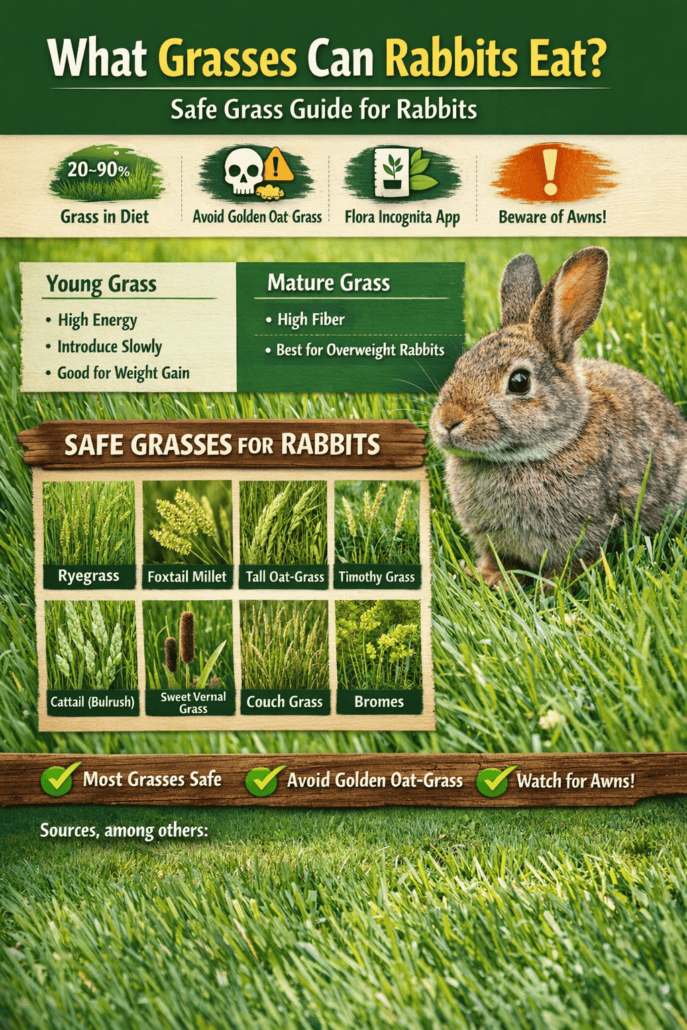
Grasses play a major role in a rabbit’s natural diet. When feeding meadow forage, grass should make up around 20–90% of the portion.
Are There Poisonous Grasses for Rabbits?
Most true grasses (Poaceae) are safe for rabbits.
However:
- Golden oat-grass can cause dangerously high vitamin D intake and may become toxic depending on the amount.
- Fungal toxins (endophytes) can occur on grasses, but in normal quantities they usually do not pose a problem for rabbits.
Important Safety Warning: Awns Are Dangerous
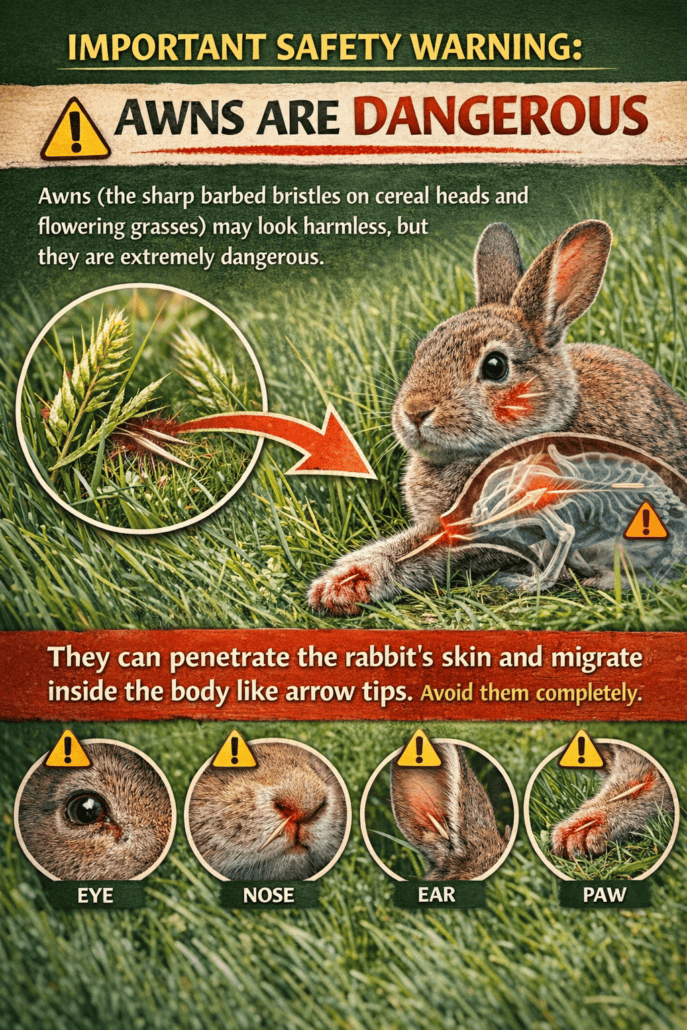
Awns (the sharp barbed bristles on cereal heads and flowering grasses) may look harmless, but they are extremely dangerous.
They can penetrate the rabbit’s skin and migrate inside the body like arrow tips. Avoid them completely.
Young Grass or Mature Grass – What Is Better for Rabbits?
Young Grass (Spring Grass)
- High in energy
- High in protein
- Low in fiber
➡ Rabbits must be slowly accustomed over about 10 days, especially the first two days, to avoid digestive issues.
Great for underweight rabbits.
Older / Mature Grass
- High in structural fiber (supports digestion)
- Low in energy
➡ Perfect for overweight rabbits and general digestive stability. Most pet rabbits are fed too much energy, so older grasses are ideal.
Flowering Grass
Often has little nutritional value and is extremely low in energy.
But be careful: the flower heads themselves are energy-rich and not suitable for overweight rabbits.
How to Identify Grasses
Grasses are easiest to identify when they are in bloom.
The Flora Incognita app works very reliably for identification.
List of Safe Grasses Rabbits Can Eat
Below is a comprehensive list of safe rabbit grasses, including nutritional notes and suitability.
Black-grass (Alopecurus myosuroides)
Low-energy, ideal for rabbits.
Foxtail Millet (Setaria)
Safe and suitable, rather sparse but good forage.
Ryegrass / Perennial Ryegrass / Italian Ryegrass (Lolium perenne, Lolium multiflorum)
Energy-rich but feedable. Lower-energy grasses are preferable.
Tall Oat-Grass (Arrhenatherum elatius)
Safe to feed.
Pendulous Sedge (Carex pendula)
Edible, usually eaten reluctantly. Belongs to sedges.
Barnyard Grass (Echinochloa crus-galli)
Safe for rabbits. Indicator of nitrogen-rich soils.
Crested Dog’s-Tail (Cynosurus cristatus)
Edible.
Cocksfoot / Orchard Grass (Dactylis glomerata)
Very suitable rabbit forage. Flowers May–June.
Tufted Hair-Grass (Deschampsia cespitosa)
Safe to feed.
Rough Meadow-Grass (Poa trivialis)
Common, edible, slightly energy-rich. Prefers moist and shady areas.
Cattail / Bulrush (Typha latifolia)
Edible. Grows in wetlands and near water.
Kentucky Bluegrass / Meadow Grass (Poa pratensis)
Very widespread, slightly energy-rich, safe to feed.
Sweet Vernal Grass (Anthoxanthum)
Energy-poor, safe to feed, sometimes smells like woodruff.
Common Reed (Phragmites australis)
Low energy, safe for rabbits. Grows near water, flowers July–September.
Tall Fescue / Red Fescue (Festuca arundinacea)
Safe.
Bentgrasses (Agrostis species)
Safe.
Bromes (Bromus sterilis, Bromus hordeaceus)
Low in energy, suitable rabbit forage.
Reed Grass (Calamagrostis arundinacea)
Safe.
Meadow Foxtail (Alopecurus pratensis)
Nutrient-rich, edible for rabbits. Flowers April–July.
Golden Oat-Grass (Trisetum flavescens)
⚠ Dangerous in excess due to vitamin D overdose risk. Can act toxic depending on intake.
Timothy Grass (Phleum pratense)
Very common rabbit grass. Completely safe.
Yorkshire Fog (Holcus lanatus)
Safe. Flowers May–August.
Quaking Grass (Briza media)
Safe to feed.
Couch Grass (Elymus)
Completely safe.
Final Summary
- Most grasses are safe for rabbits.
- Golden oat-grass is the main concern due to vitamin D toxicity risk.
- Young grass = higher energy → introduce slowly.
- Older grass = fiber-rich → better for digestion and overweight rabbits.
- Avoid awns completely due to injury risk.
Sources including
Infection Rates and Alkaloid Patterns of Different Grass Species with Systemic Epichloë Endophytes. Veronika Vikuk, Carolyn A. Young, Stephen T. Lee, Padmaja Nagabhyru, Markus Krischke, Martin J. Mueller, Jochen Krauss. Applied and Environmental Microbiology, DOI: 10.1128/AEM.00465-19